













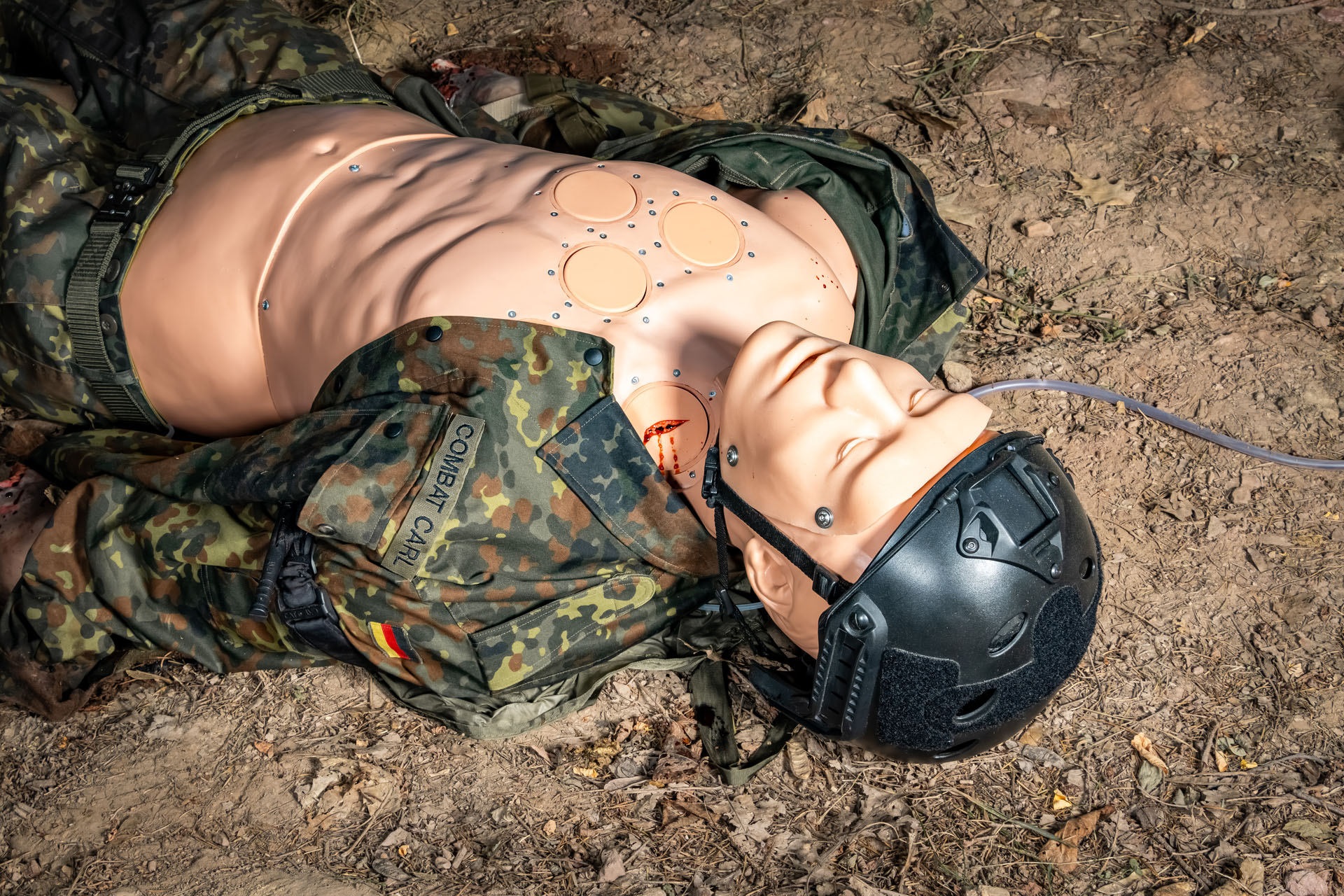
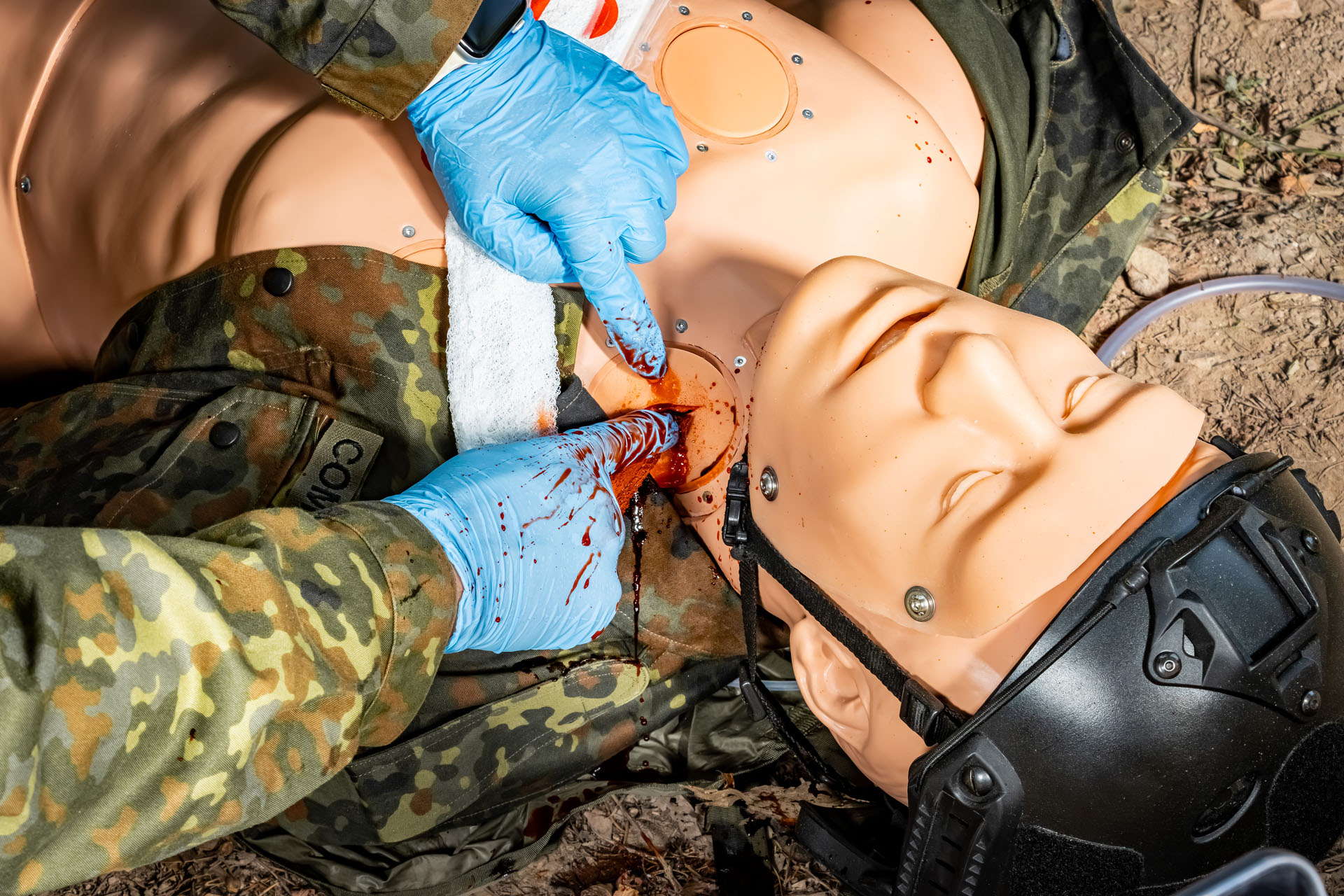
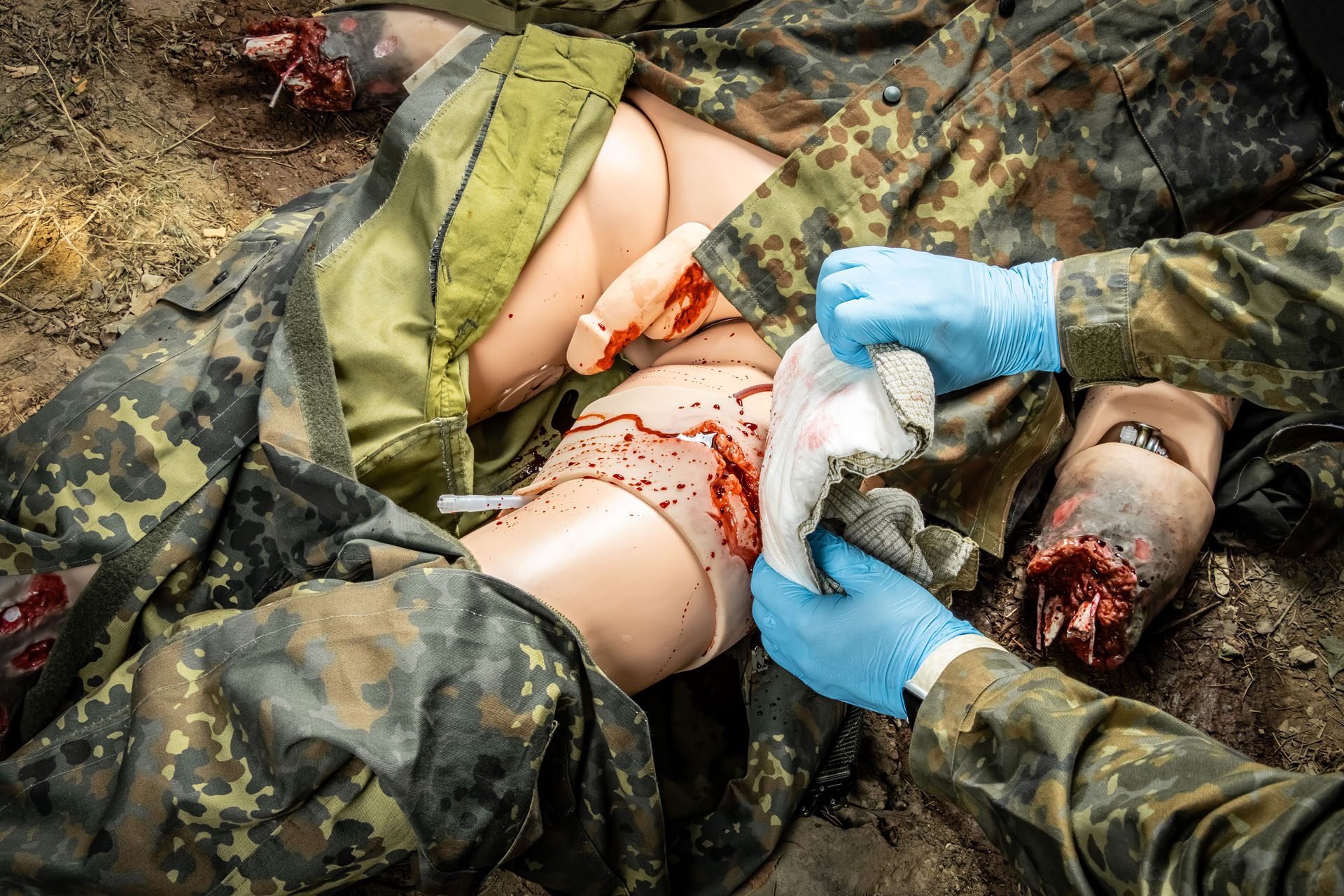
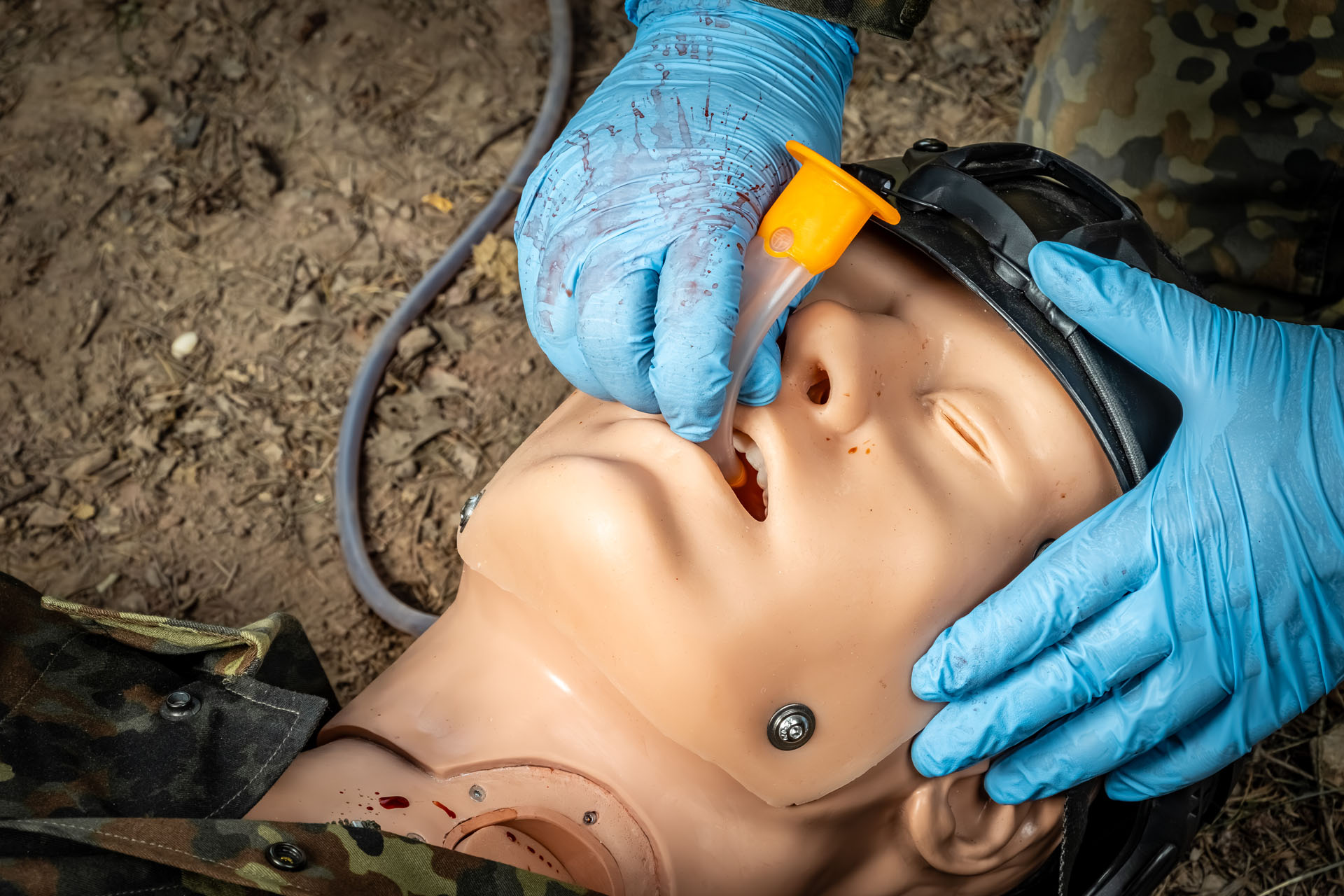
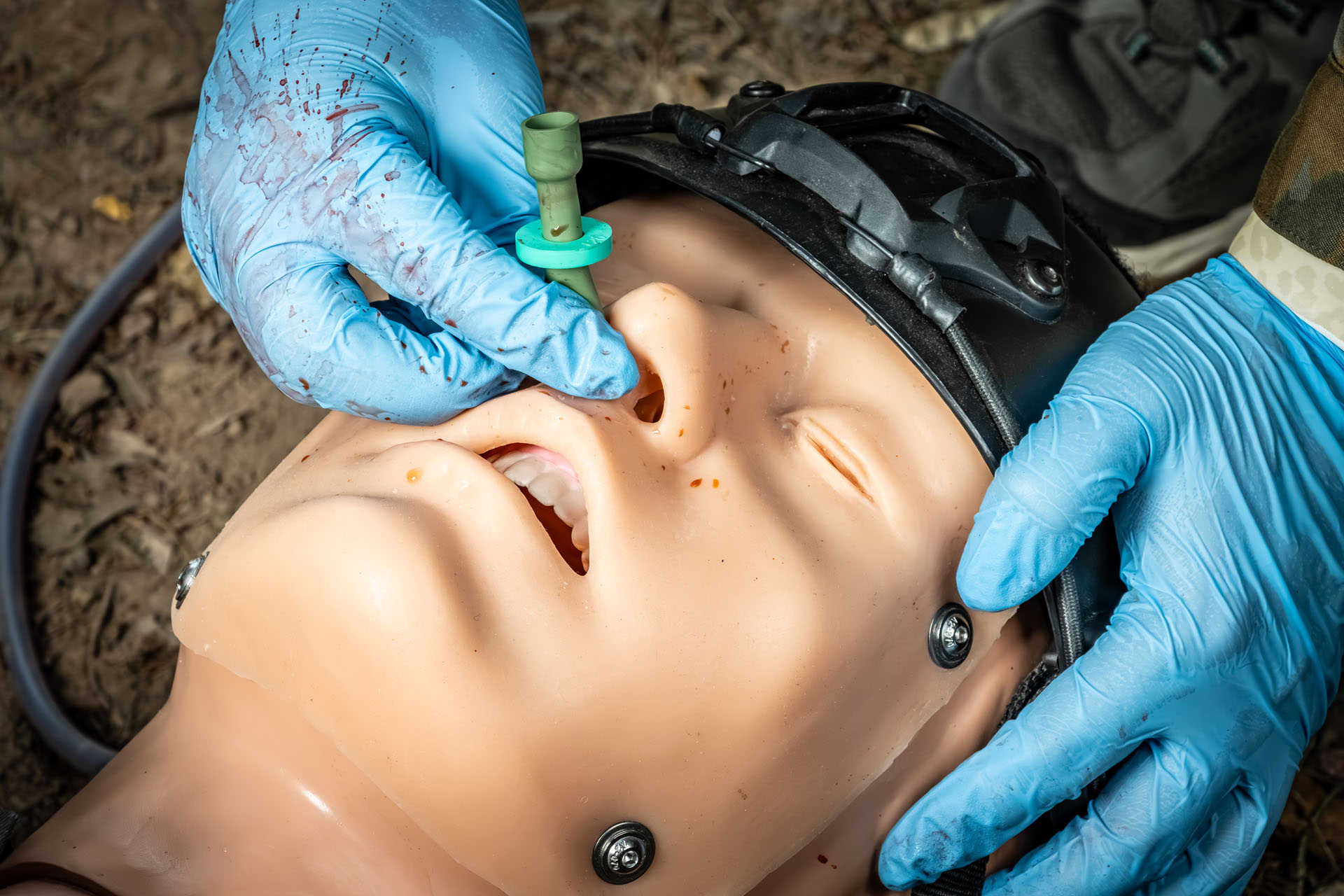
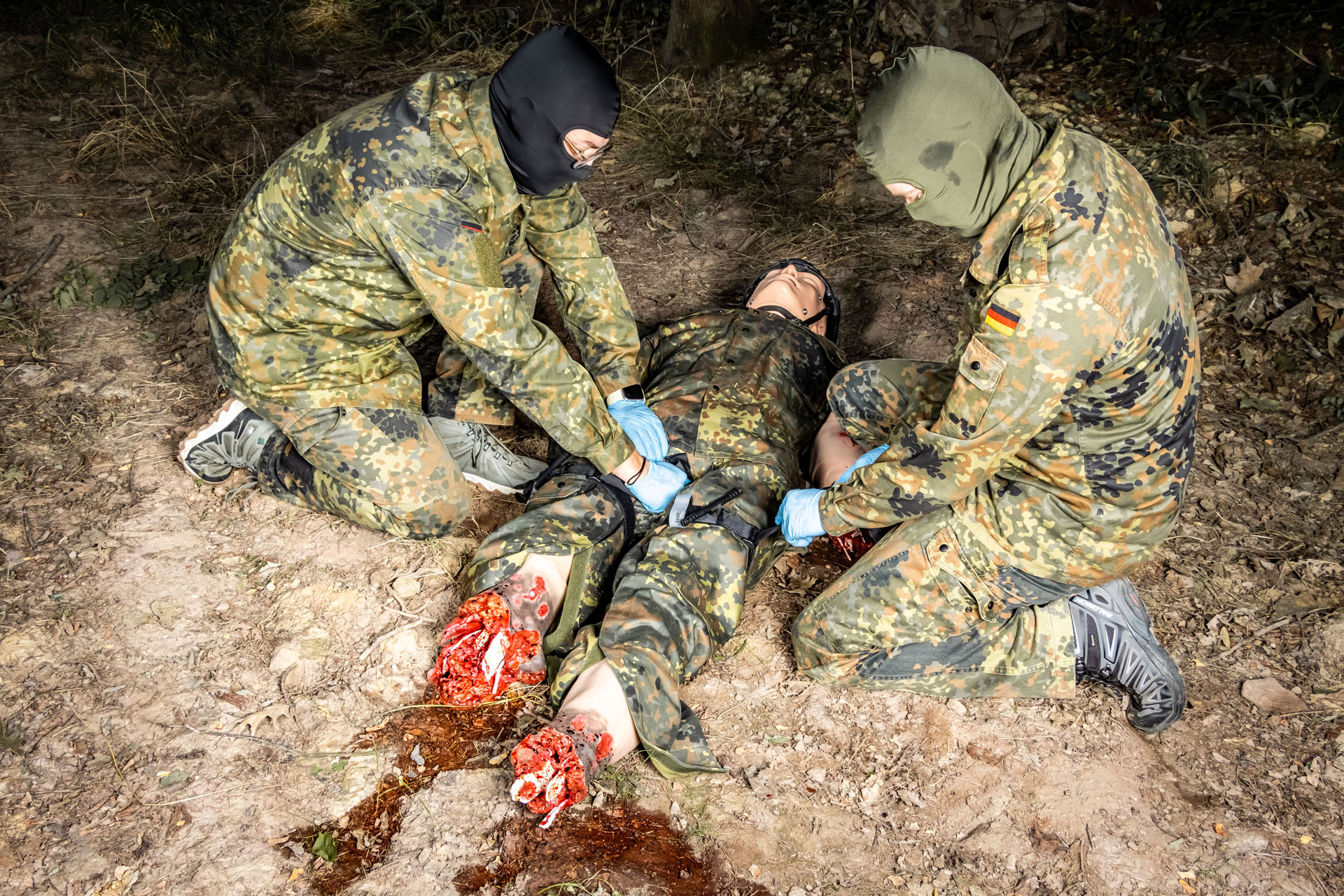
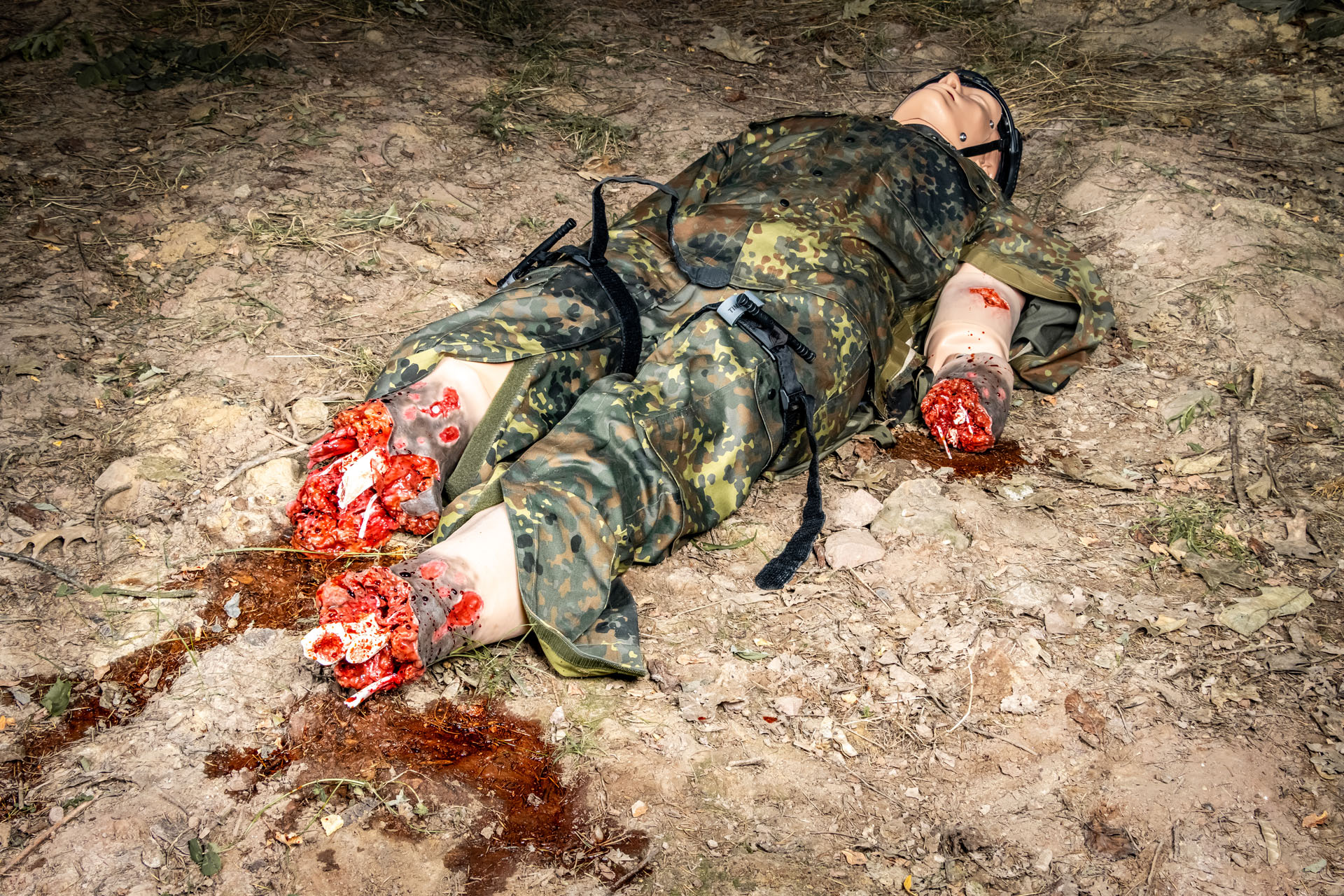
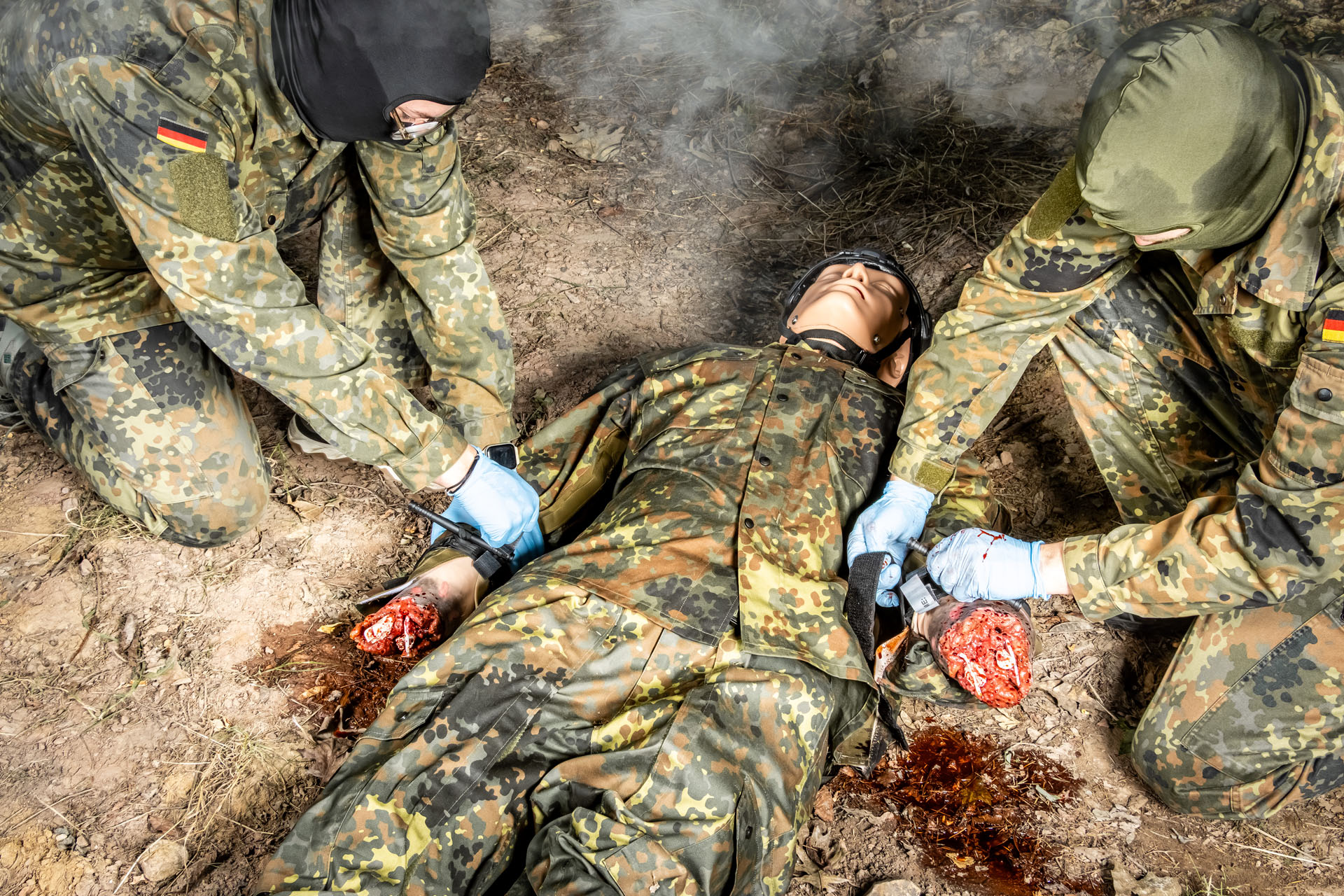



Providing medical care on the battlefield poses different challenges than in the event of an accident at home. From initial treatment in a firefight to onward transportation to a treatment facility, soldiers risk their lives and Combat Carl can be used to map the complete MARCH scheme.
M - Treatment of massive bleeding
A - Airway
R - Respiration
C - Circulation
H - Hypothermia / Head Injuries
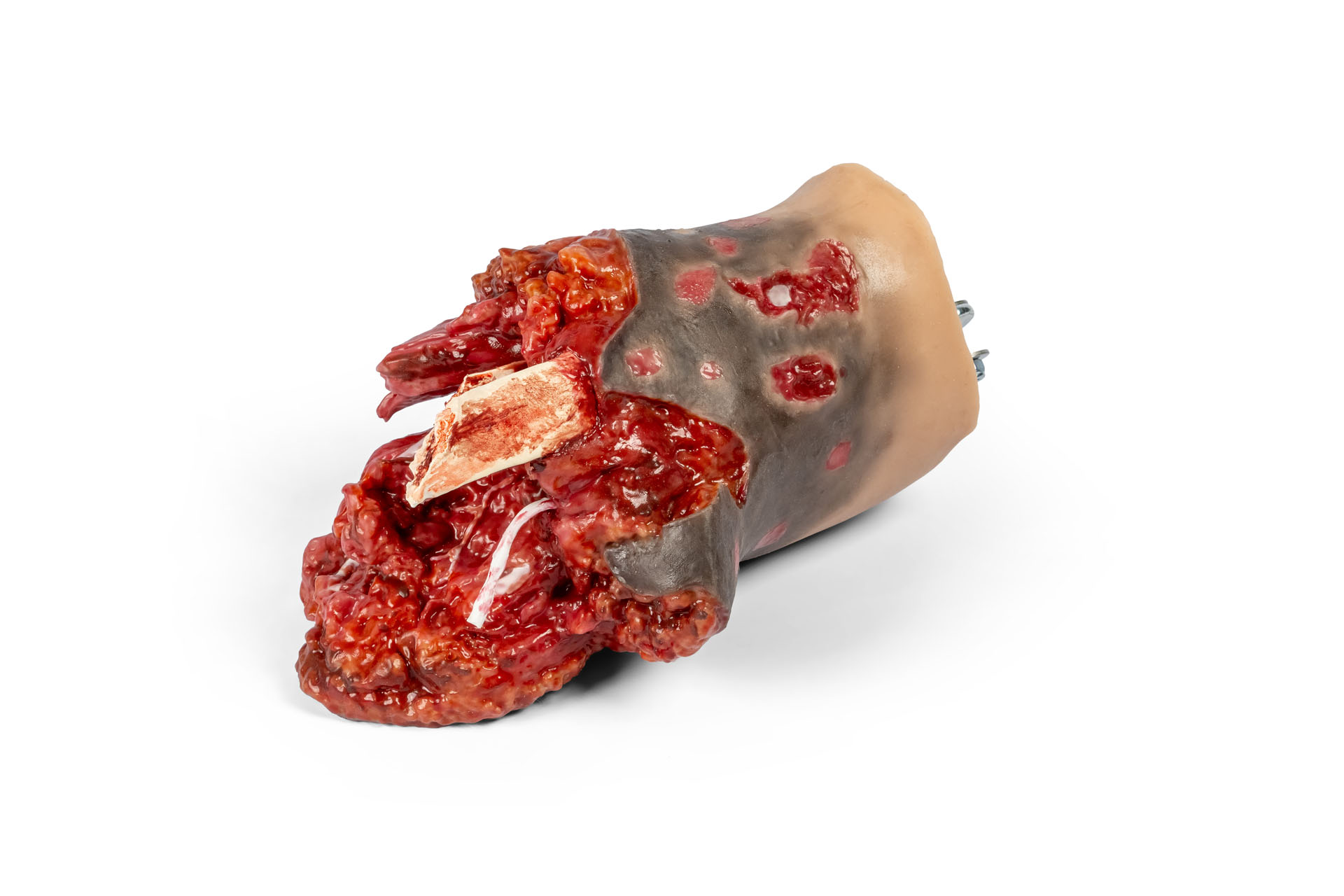
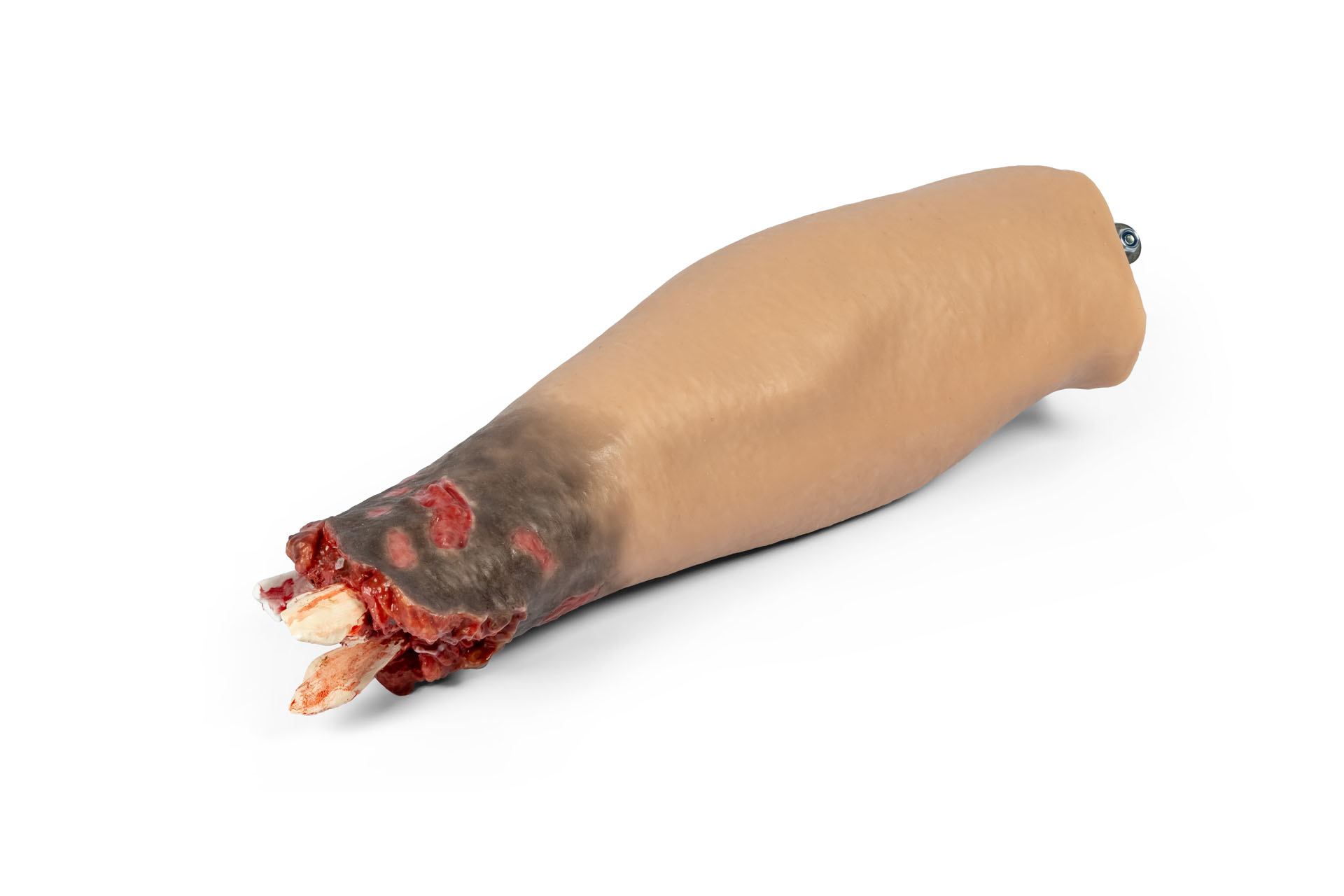
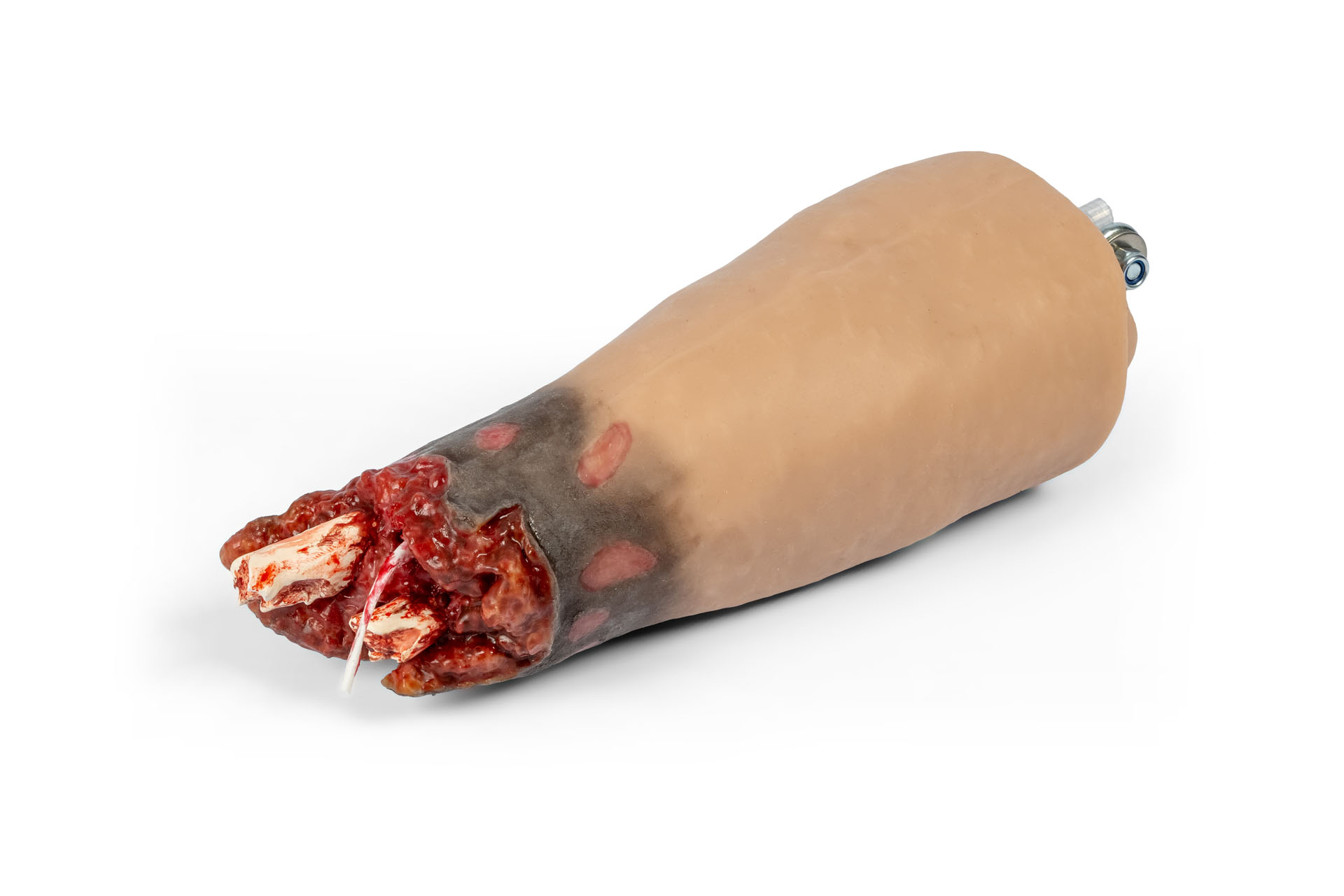
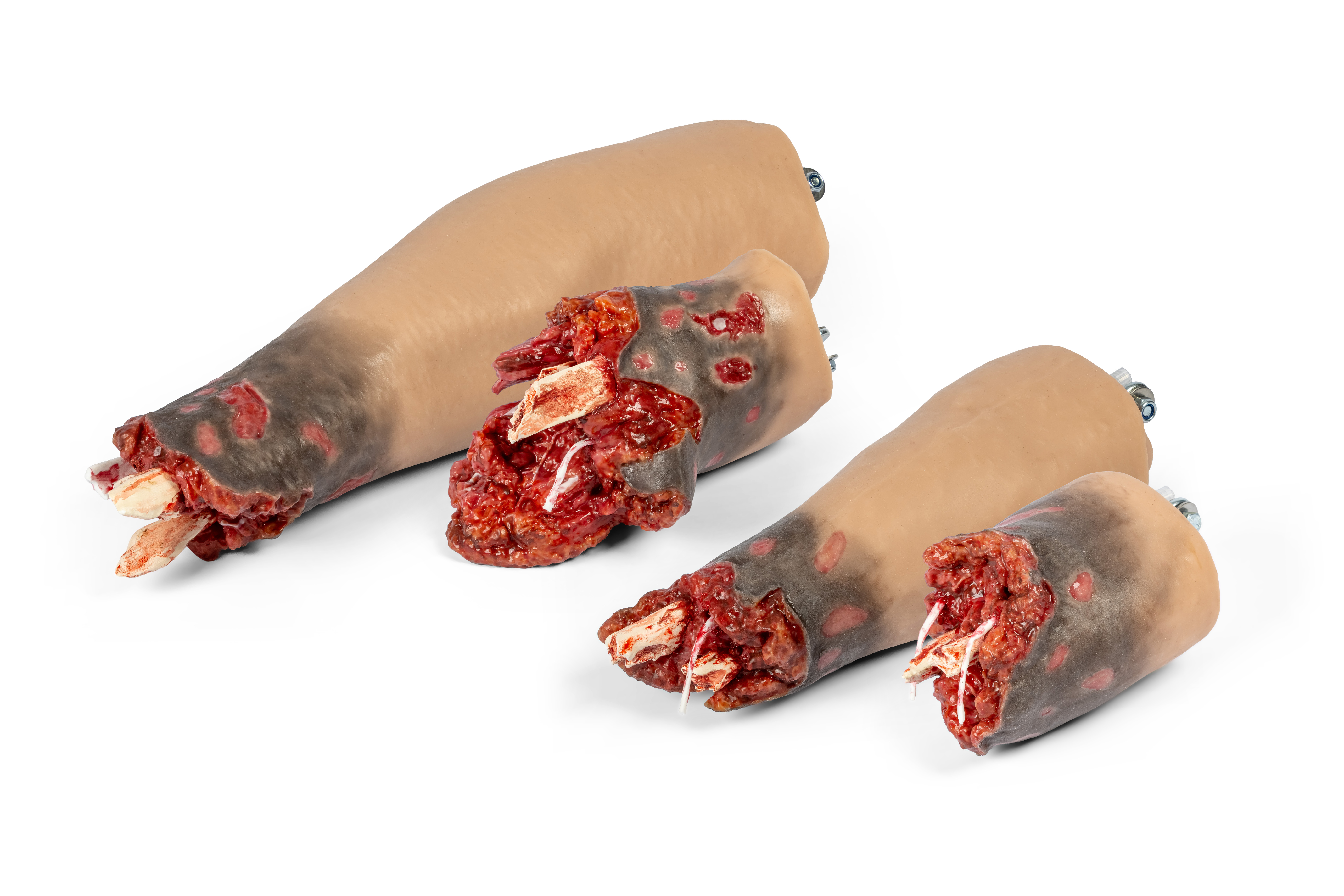
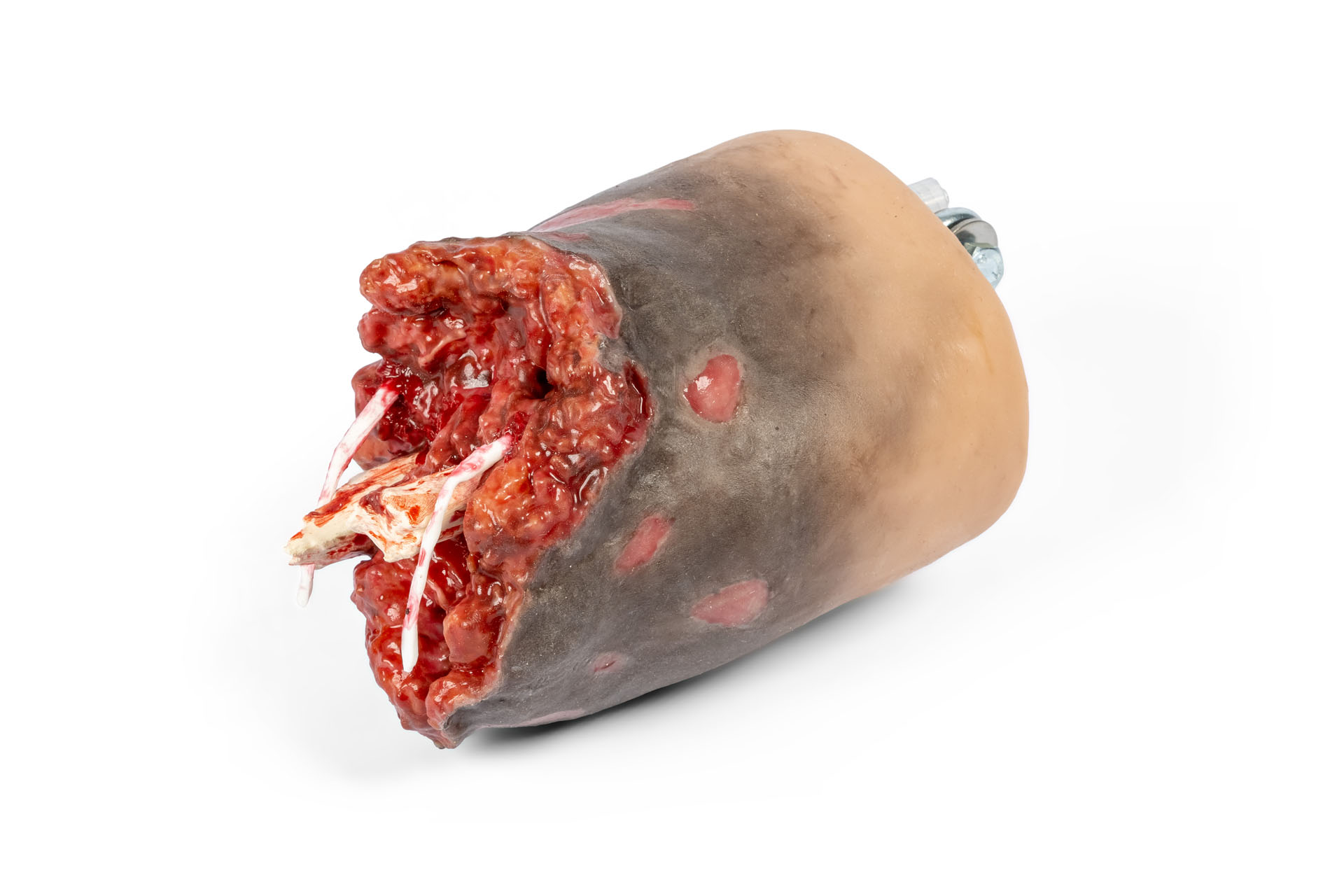
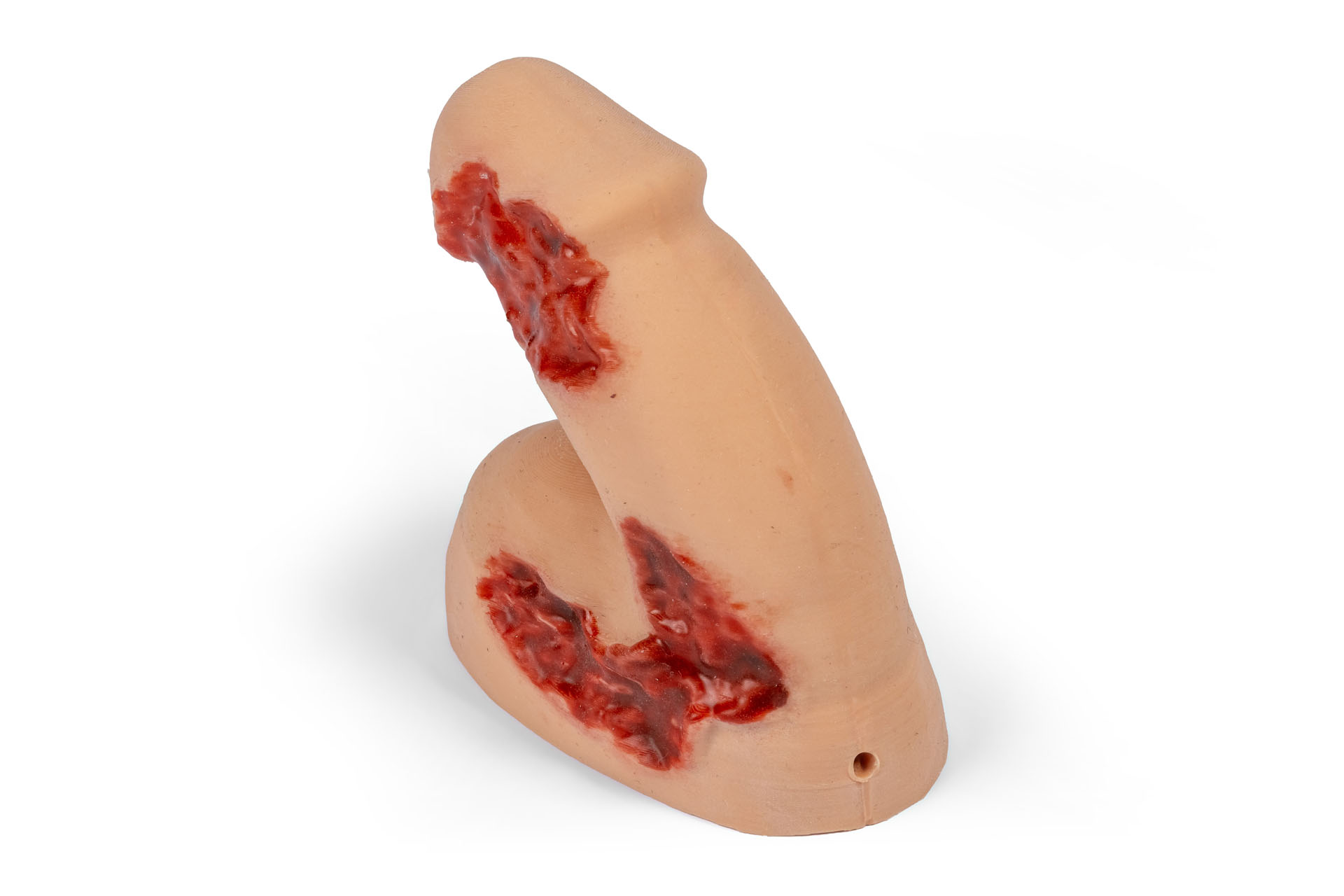
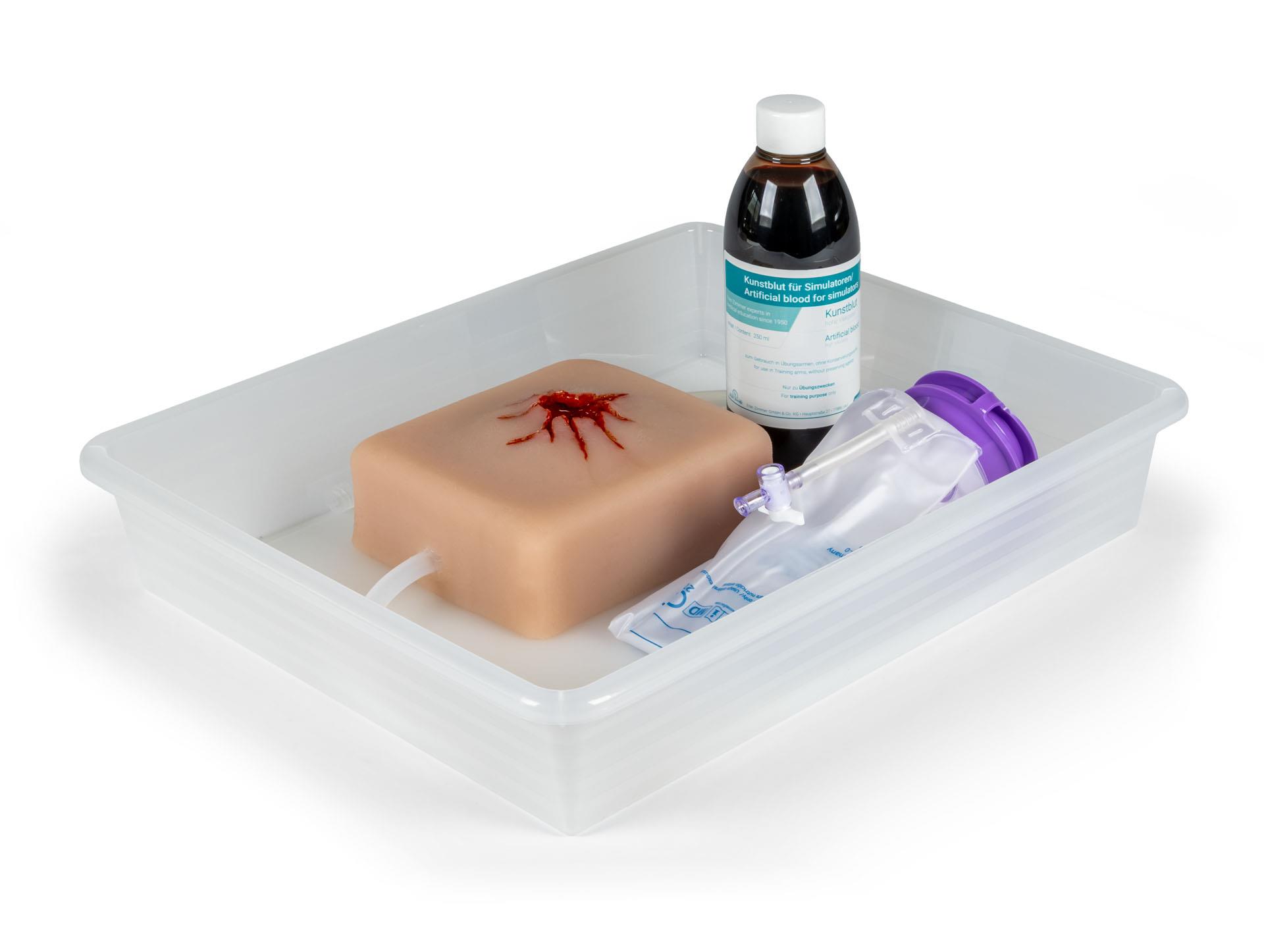
Although the military-tactical procedure may vary depending on the different threats in the combat situation, the basic philosophy of casualty care always remains the same. Combat Carl can optionally be equipped with amputation stumps or realistic wound moulages.
During the first phase, “Care Under Fire”, the aim is to guide a wounded person to self-help as quickly as possible, despite the possibility of ongoing hostilities, in order to bring them to a safe area away from the fighting and treat them. Almost 18 percent of fatalities can be avoided if specially trained first aiders provide care within the first ten minutes, the so-called Platinum Ten Minutes.
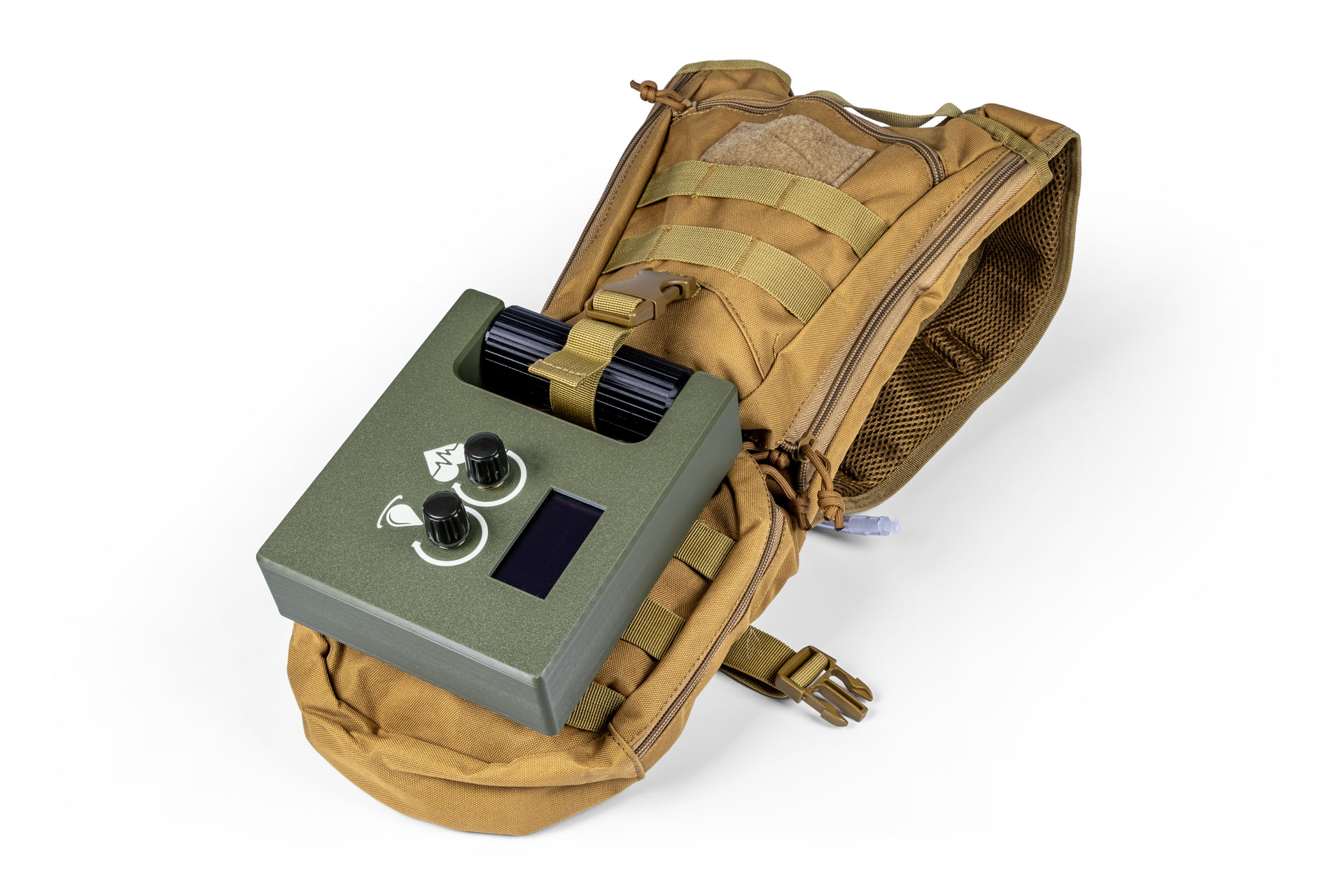
For this reason, great importance is attached to self-help and helping others. This enables them to provide first aid under tactical conditions. Simple haemostatic measures for gunshot wounds are carried out using self-adhesive and extremely realistic wound dressings and can be treated using a tourniquet, increasing the wounded person's chances of survival. Applying a tourniquet to the extremities prevents excessive blood loss and the resulting death from bleeding to death. Ideal for training with the bleeding module which can be controlled via an APP.
In the second phase, “Tactical Field Care”, a standardized examination according to the MARCH scheme can now be carried out for the first time without enemy action. This scheme is repeated continuously.
This is followed by the third and final phase, “Tactical Evacuation Care”. This comprises the preparation and implementation of qualified tactical casualty transportation to a field hospital or field hospital. Various means of transportation are available for this transport phase, depending on the operational situation. Ideally, this is the rescue helicopter equipped with intensive care equipment. Specially armored vehicles such as a transport tank serve as a means of rescue by land. The basic aim of TCCC - Tactical Combat Casualty Care is to adhere to operationally defined timelines. After basic first aid, the “Platinum Ten Minutes”, the wounded must be evacuated from the dangerous situation within the so-called “Golden Hour”. Further surgical treatment is then carried out in a sterile environment.
Features:
- Weight from approx. 65kg to 85kg
- Realistic size 175cm
- Robust PVC material
- Ideal for outdoor use under extreme conditions (sand, rain, mud etc.)
- Wound inserts incl. universal bleeding module in 7 places for changing
- Flexible extremities for different carrying techniques
- No sensitive electronics
- Made in Germany
- cABCDE scheme - Compliant
- XABCDE scheme - Compliant
- MARCH scheme - Compliant
- Voice module via Bluetooth (waterproof up to 1 meter according to IPX7)
- Interchangeable eyes, 3 pairs, normal, dilated, constricted
- Airway protection, oropharyngeal and nasopharyngeal
- Wound management 7 sites for wound modules
- Stab wound, gunshot wound, bullet wound, blind cover
- Wounds have a bleeding function for manual or automatic bleeding modules via app control
- Tourniquet system
- Dressing techniques / support and wound dressing
- Intraosseous access tibia
- Intraosseous access humerus
- Intraosseous access sternum
- Thoracic release according to Monaldi
- Thoracic release according to Bülau
- Intravenous injection
- Peripheral venipuncture
Login
July 22, 2026 12:12
Professionelles und robustes Trainingsmanikin für realitätsnahe TECC-/TCCC-Szenarien
Als TECC-/TCCC-Trainer setze ich Combat Carl regelmäßig in unseren Kursen ein. Das Manikin überzeugt insbesondere durch seine robuste Konstruktion, die realistische Größe und das hohe Gewicht. Dadurch lassen sich nicht nur medizinische Maßnahmen, sondern auch anspruchsvolle Rettungs-, Transport- und Evakuierungsszenarien praxisnah trainieren. Die flexiblen Extremitäten ermöglichen unterschiedliche Tragetechniken und erleichtern die realistische Darstellung von Einsatzlagen. Besonders hilfreich ist die Möglichkeit, verschiedene Verletzungsmuster und Blutungen einzubinden. So können die Teilnehmenden die strukturierte Versorgung nach dem MARCH-Schema unter realitätsnahen Bedingungen trainieren - vom Anlegen eines Tourniquets über das Atemwegsmanagement und die Thoraxentlastung bis zur Vorbereitung des Verwundetentransports. Ein weiterer Vorteil ist die widerstandsfähige Ausführung ohne empfindliche Elektronik. Combat Carl kann daher auch bei Outdoor-Übungen, in unwegsamem Gelände und unter schwierigen Witterungsbedingungen eingesetzt werden. Aus Sicht eines Trainers ist Combat Carl ein vielseitiges, belastbares und didaktisch wertvolles Trainingsmittel. Das Manikin unterstützt sowohl das individuelle Fertigkeitstraining als auch komplexe Team- und Einsatzszenarien. Für professionelle TECC-/TCCC-Kurse ist Combat Carl aus unserer Sicht eine klare Empfehlung.
K9-Marshal meets Workingdogs & Dogsport
Combat Carl: The Ultimate Training Manikin for Realistic Scenarios
Reality shock and team spirit: Experiencing the Tactical Medical First Aid Course up close
First Distributor meeting in Thailand was an absolute success!
Erler-Zimmer Medical GmbH
Hauptstrasse 27
77886 Lauf
Germany
info@erler-zimmer.de
Achtung! Medizinisches Ausbildungsmaterial, kein Spielzeug. Nicht geeignet für Personen unter 14 Jahren.
Attention! Medical training material, not a toy. Not suitable for persons under 14 years of age.
Other customers also bought

Continuous innovation

Social responsibility

Active customer orientation

Understanding quality

Sustainable actions

ISO 9001 certification