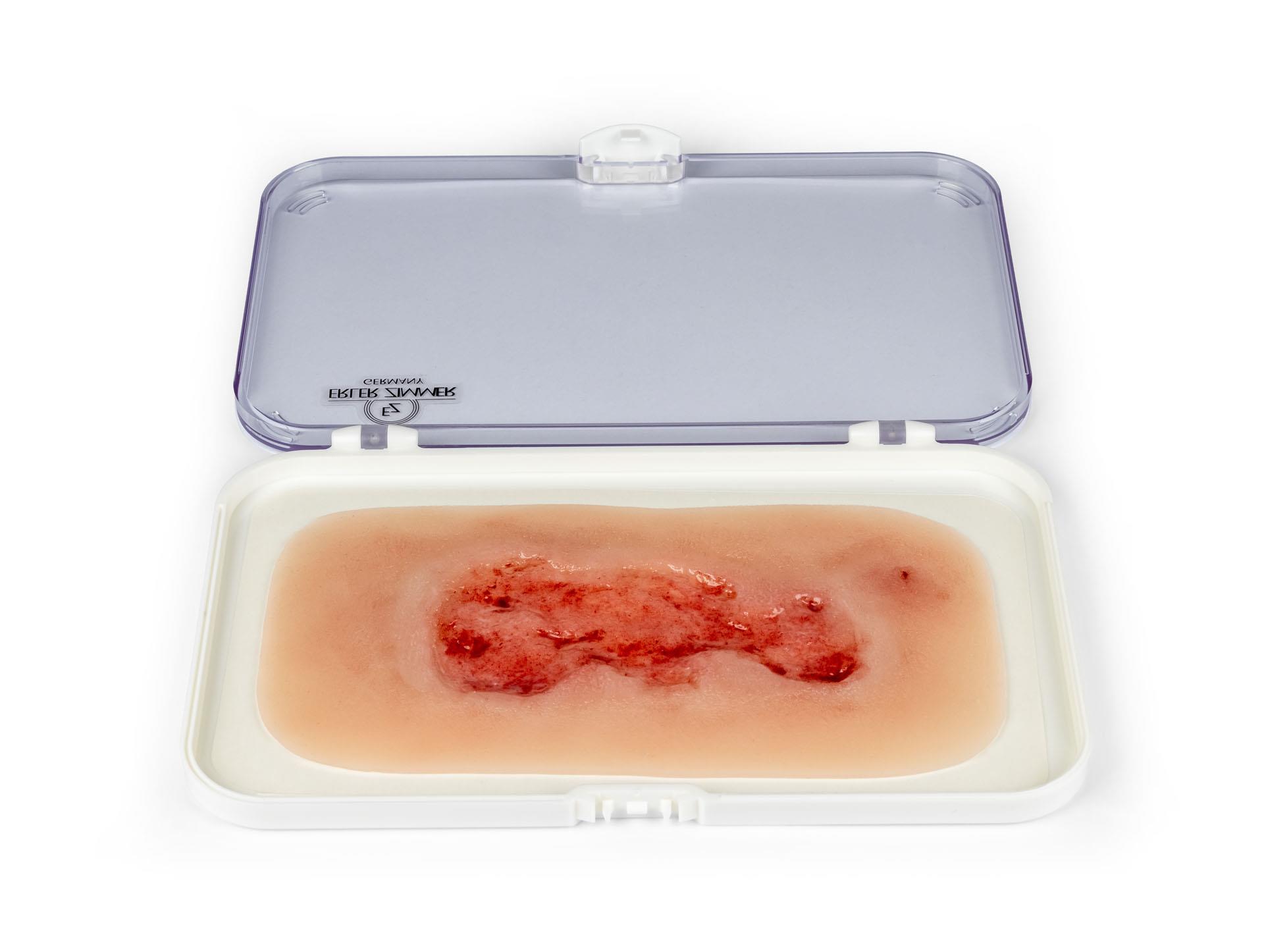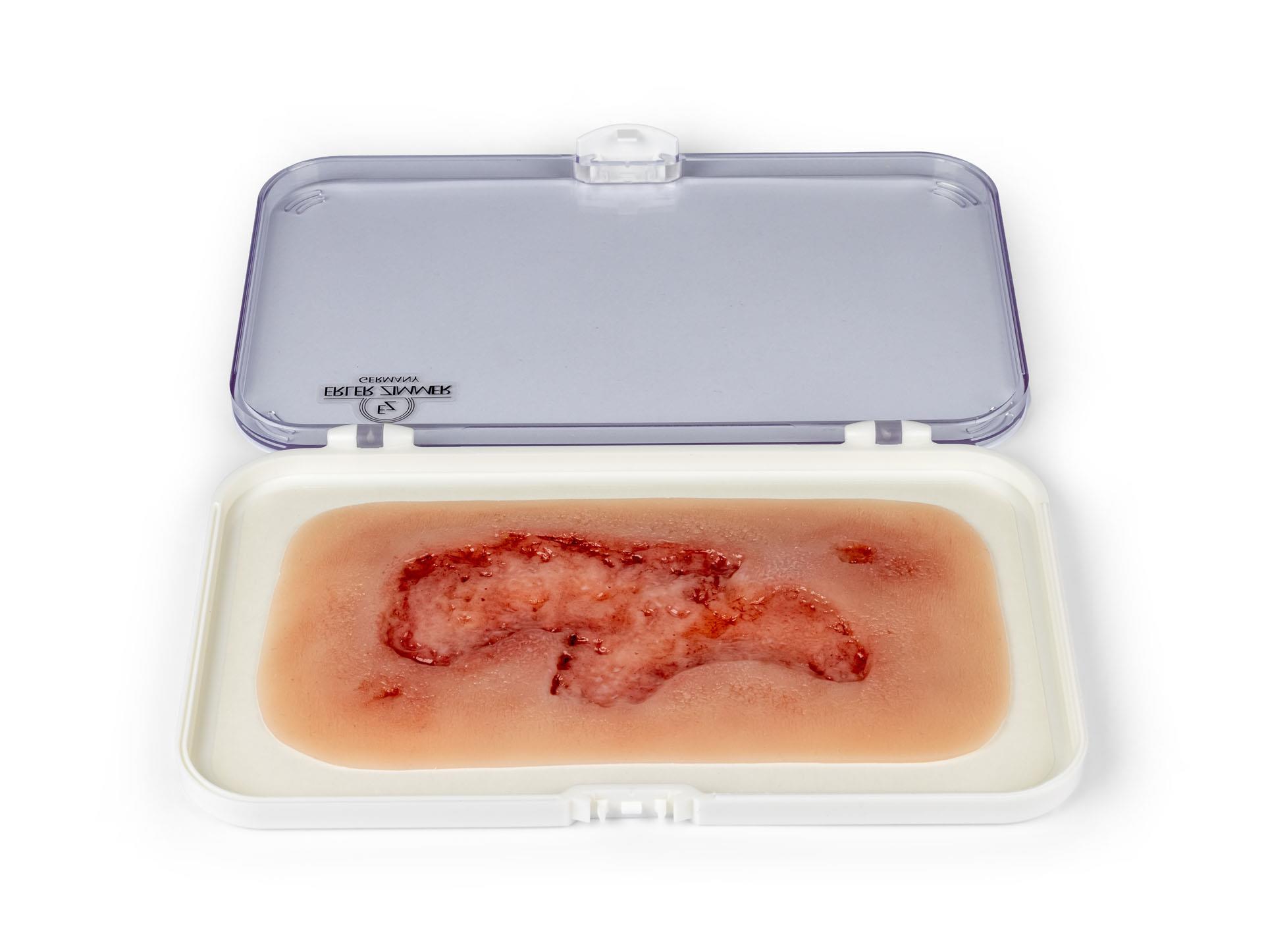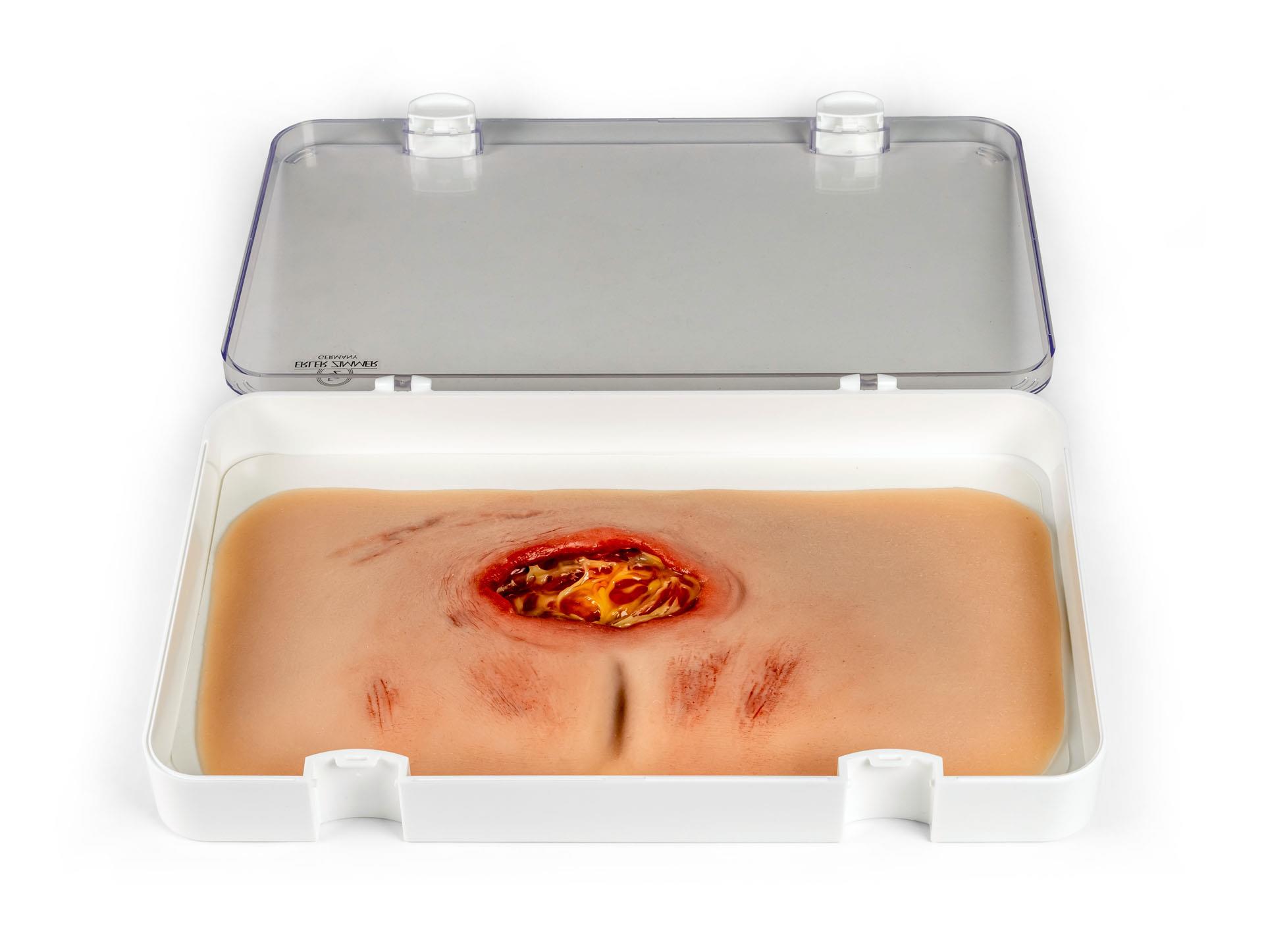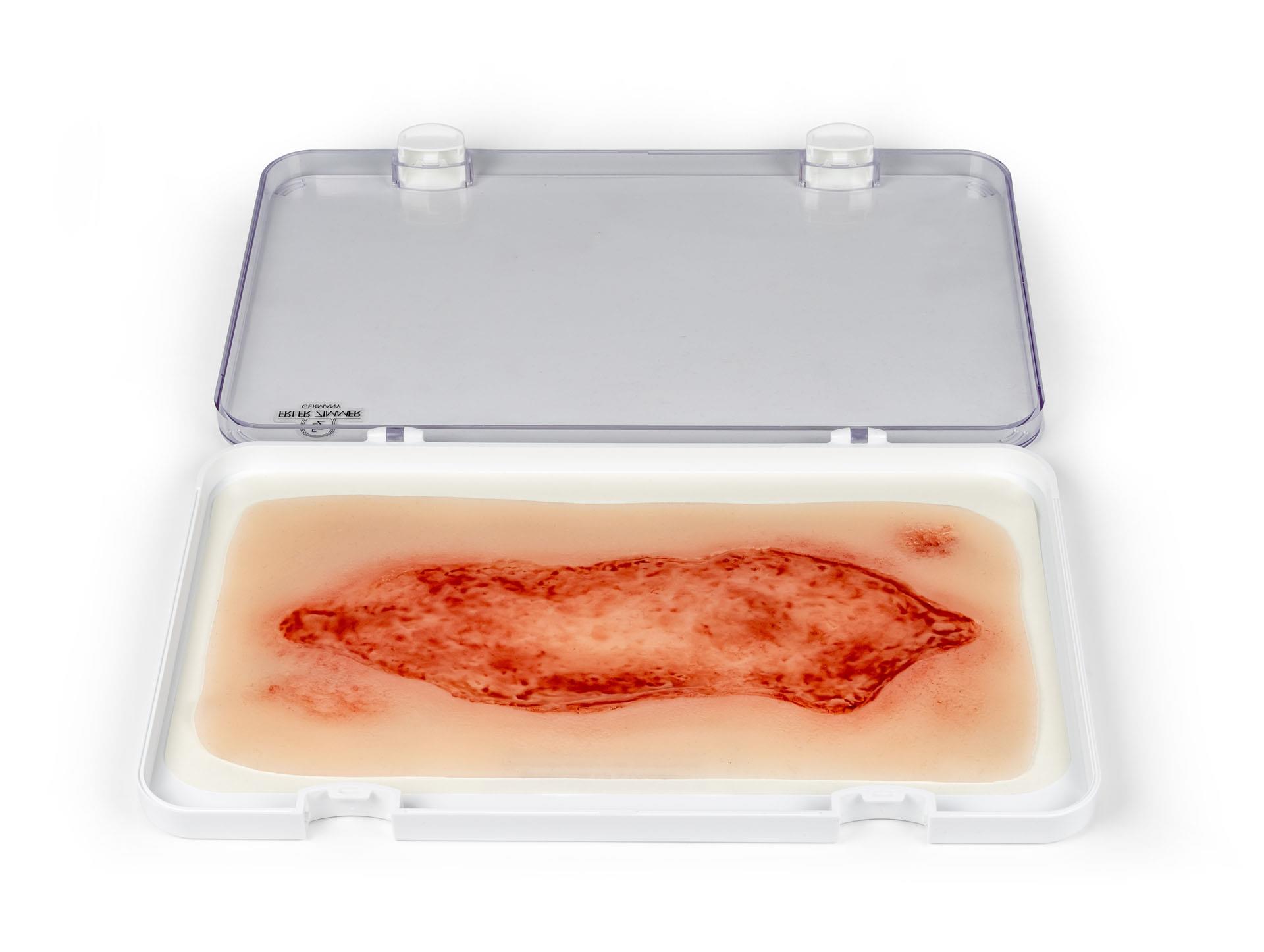







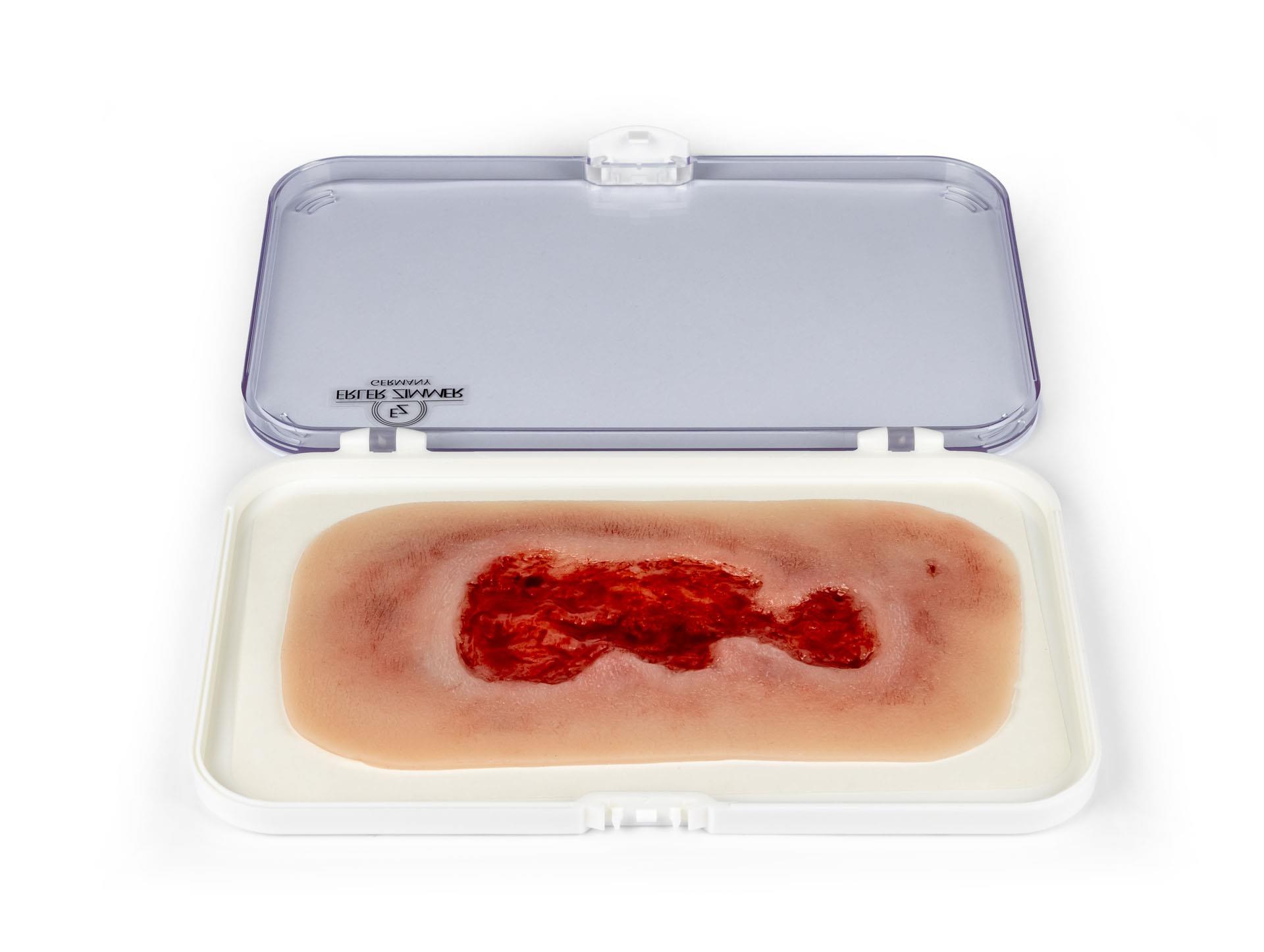
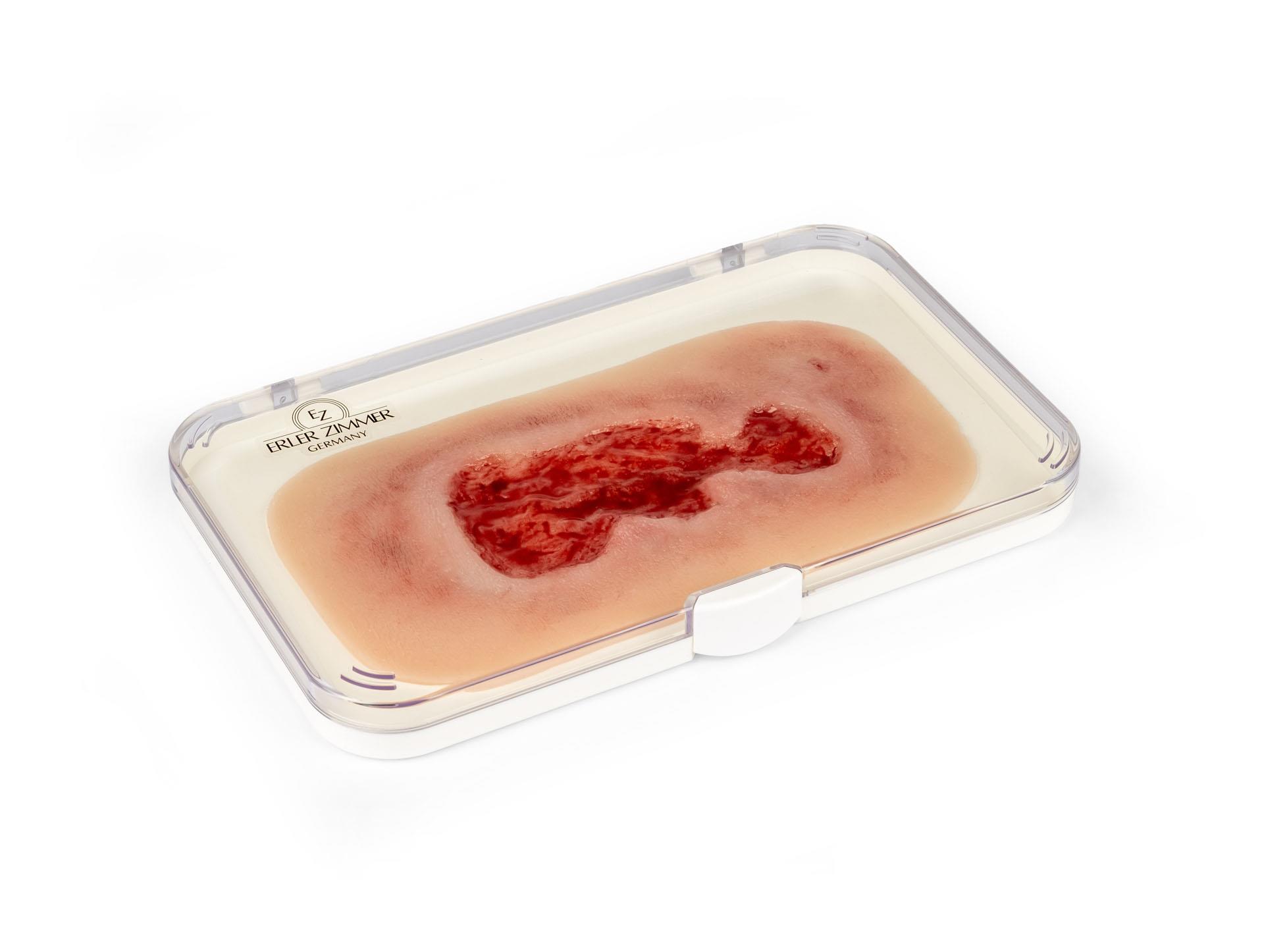
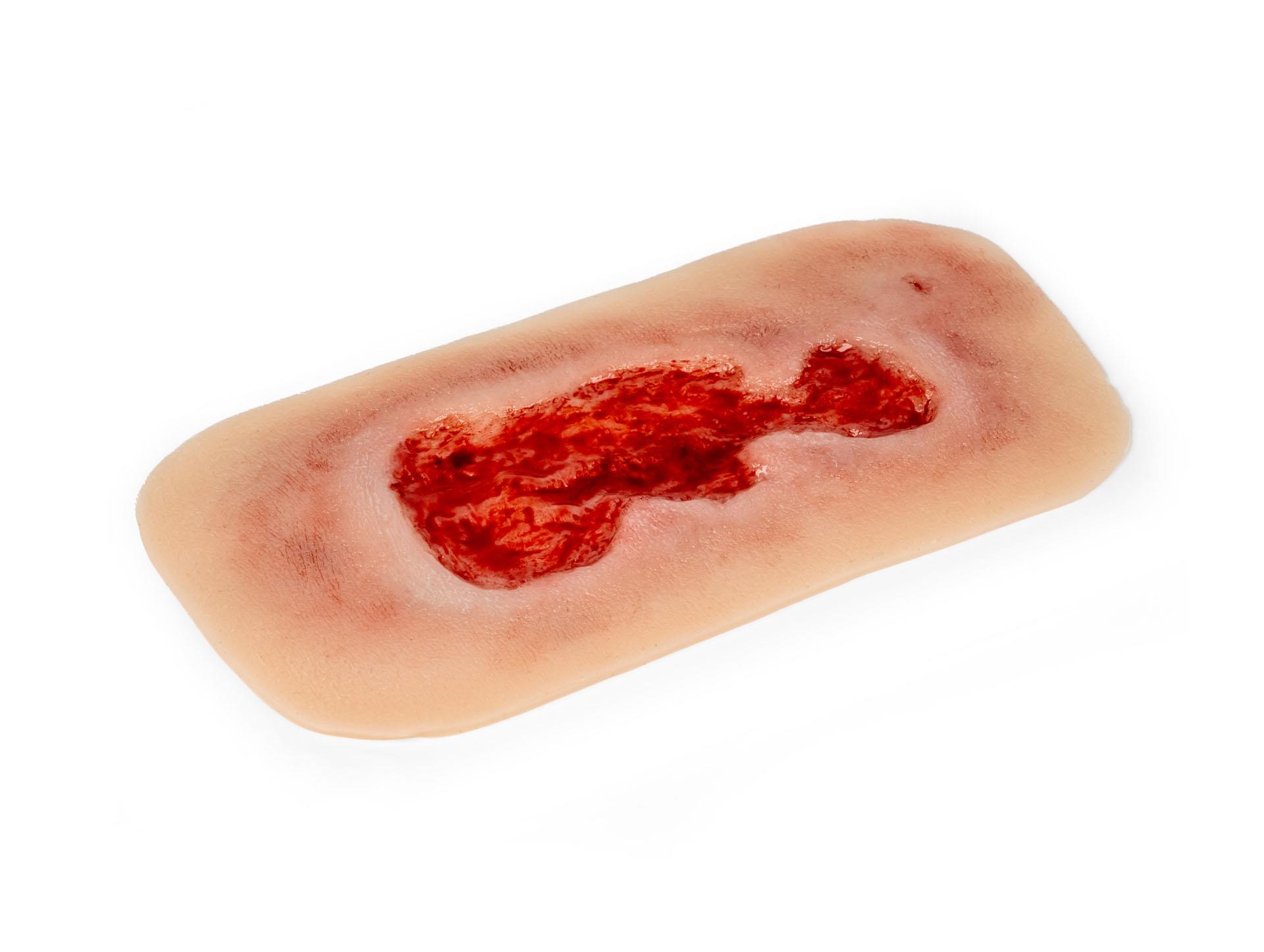
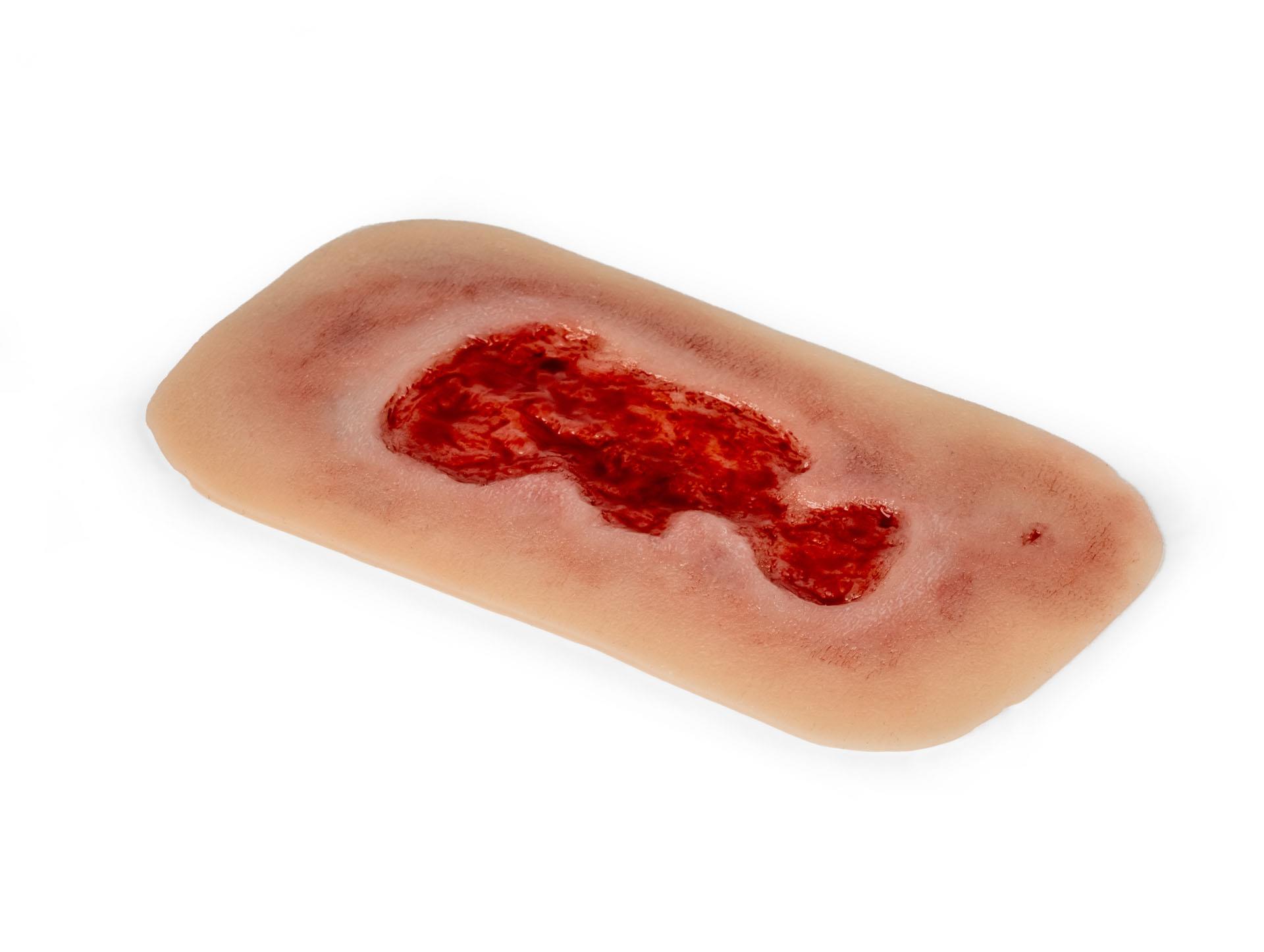
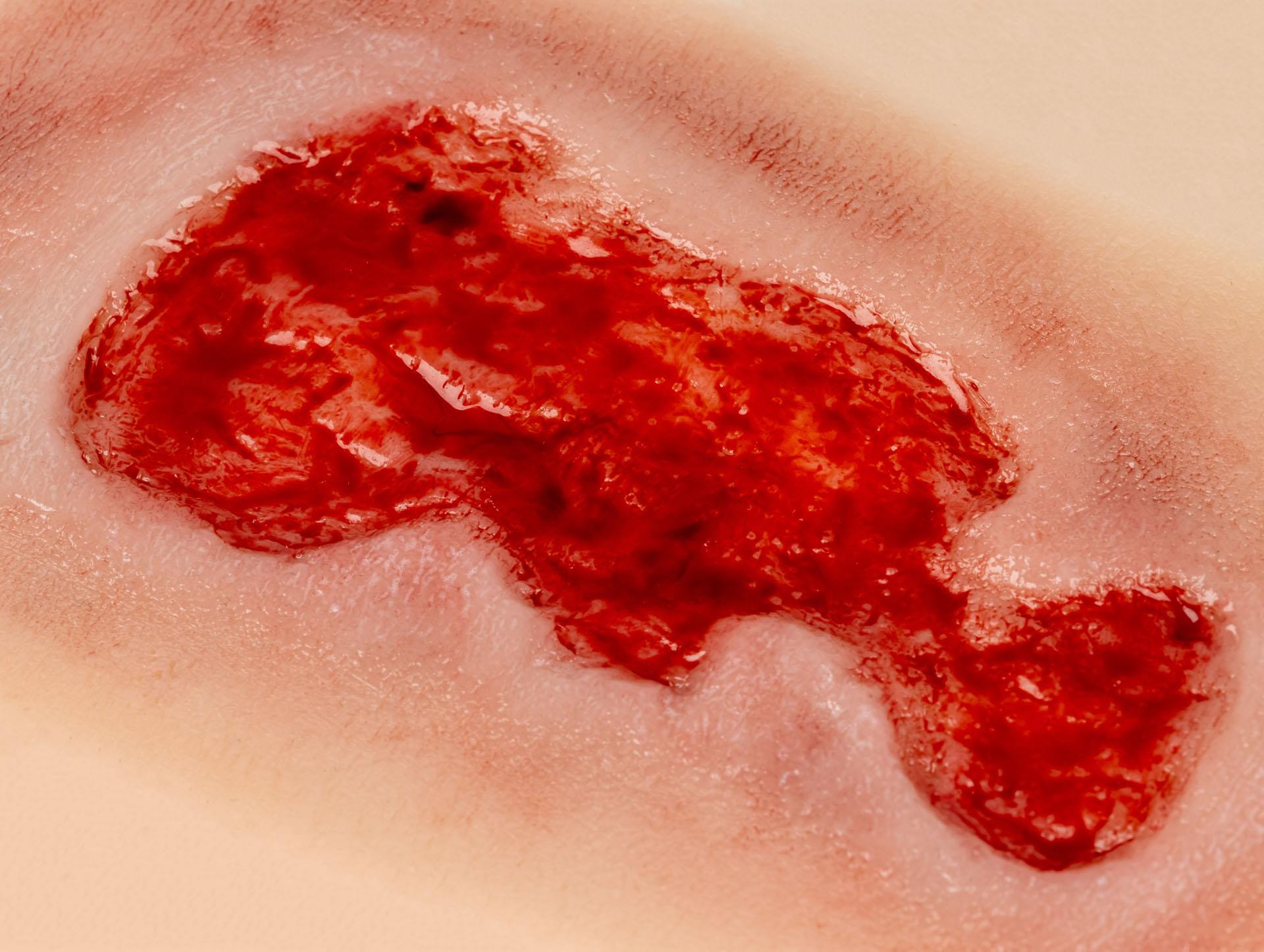
Product information "Wound moulage venous leg ulcer, small, granulation phase"
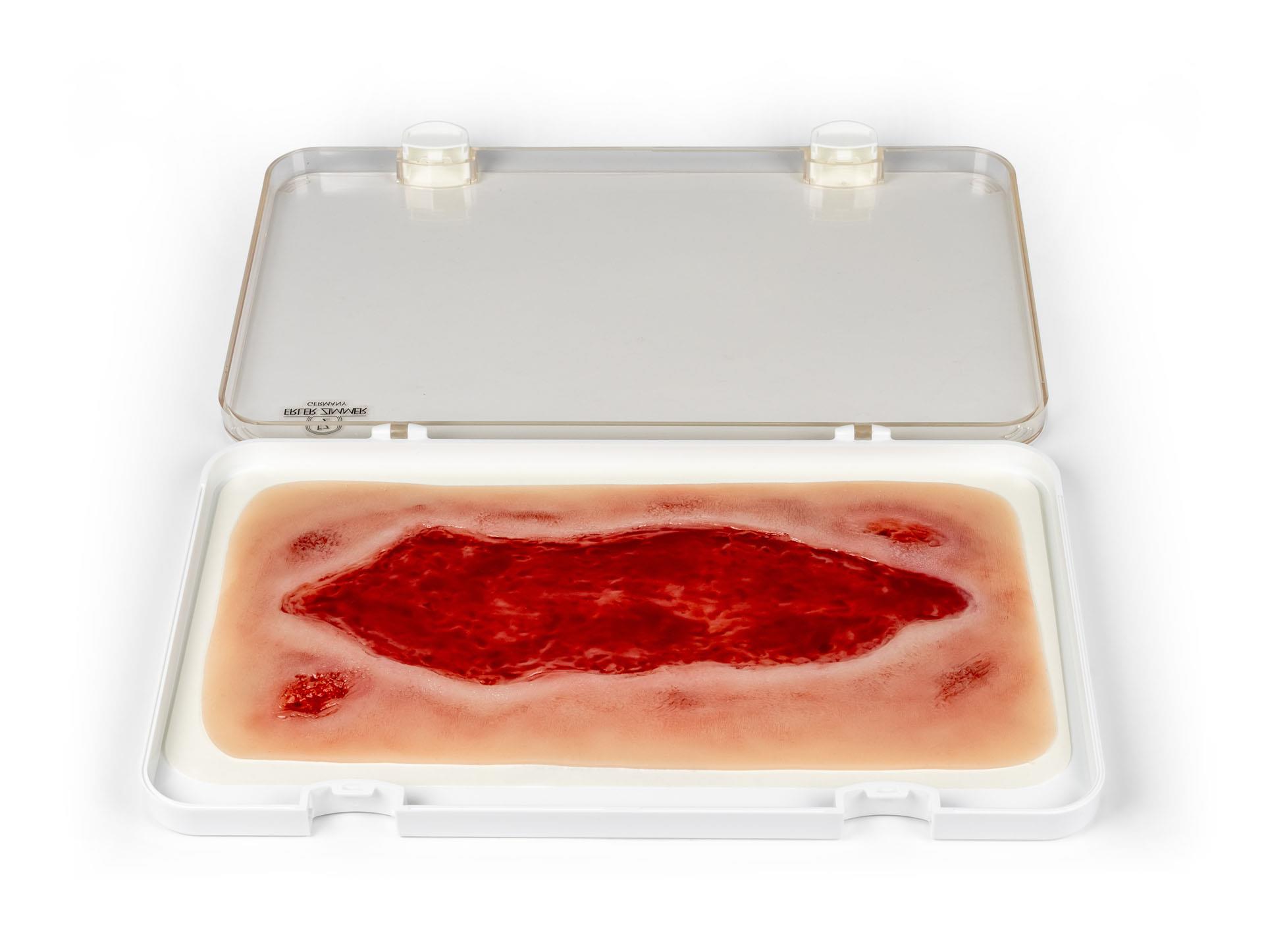
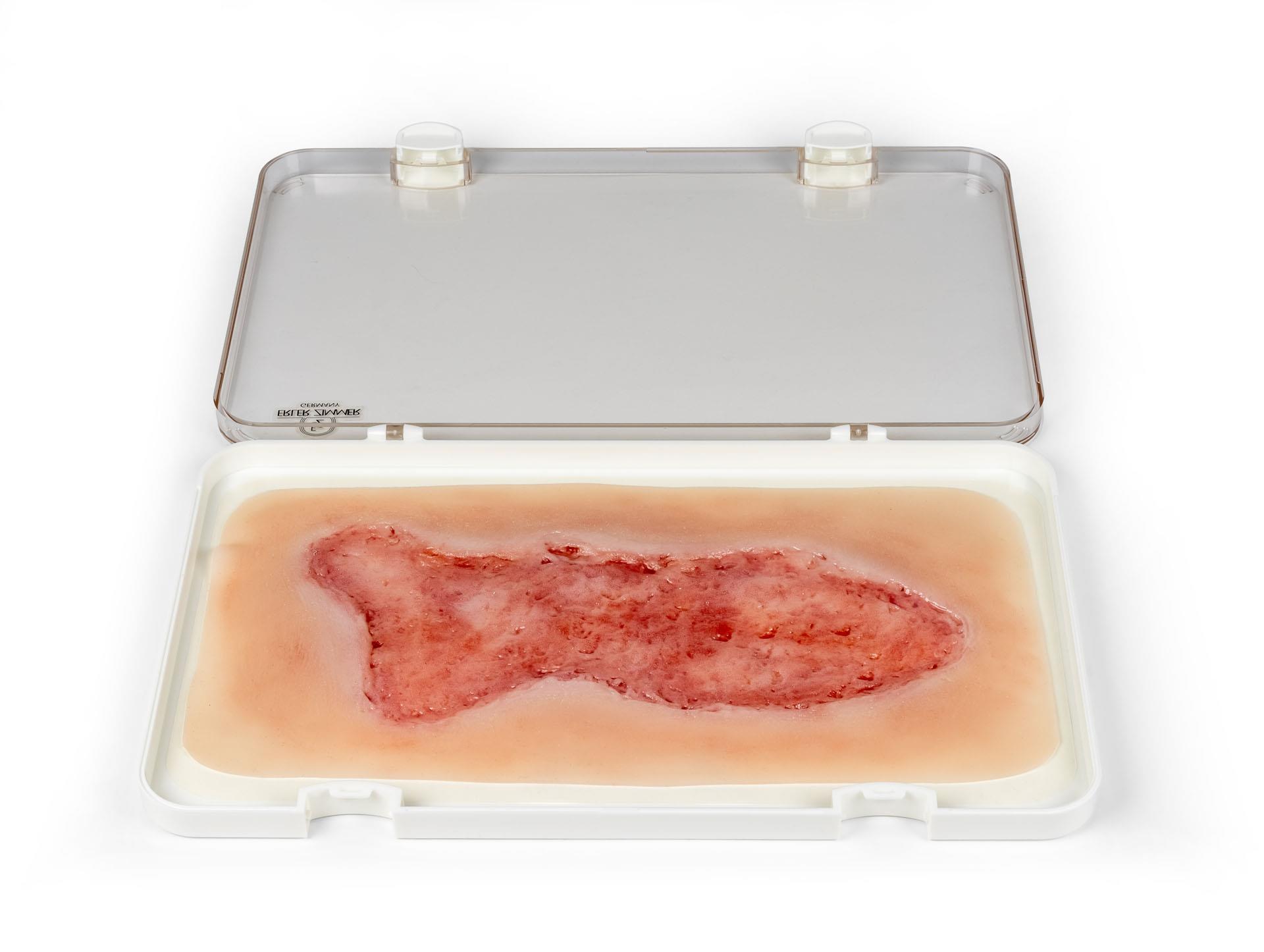
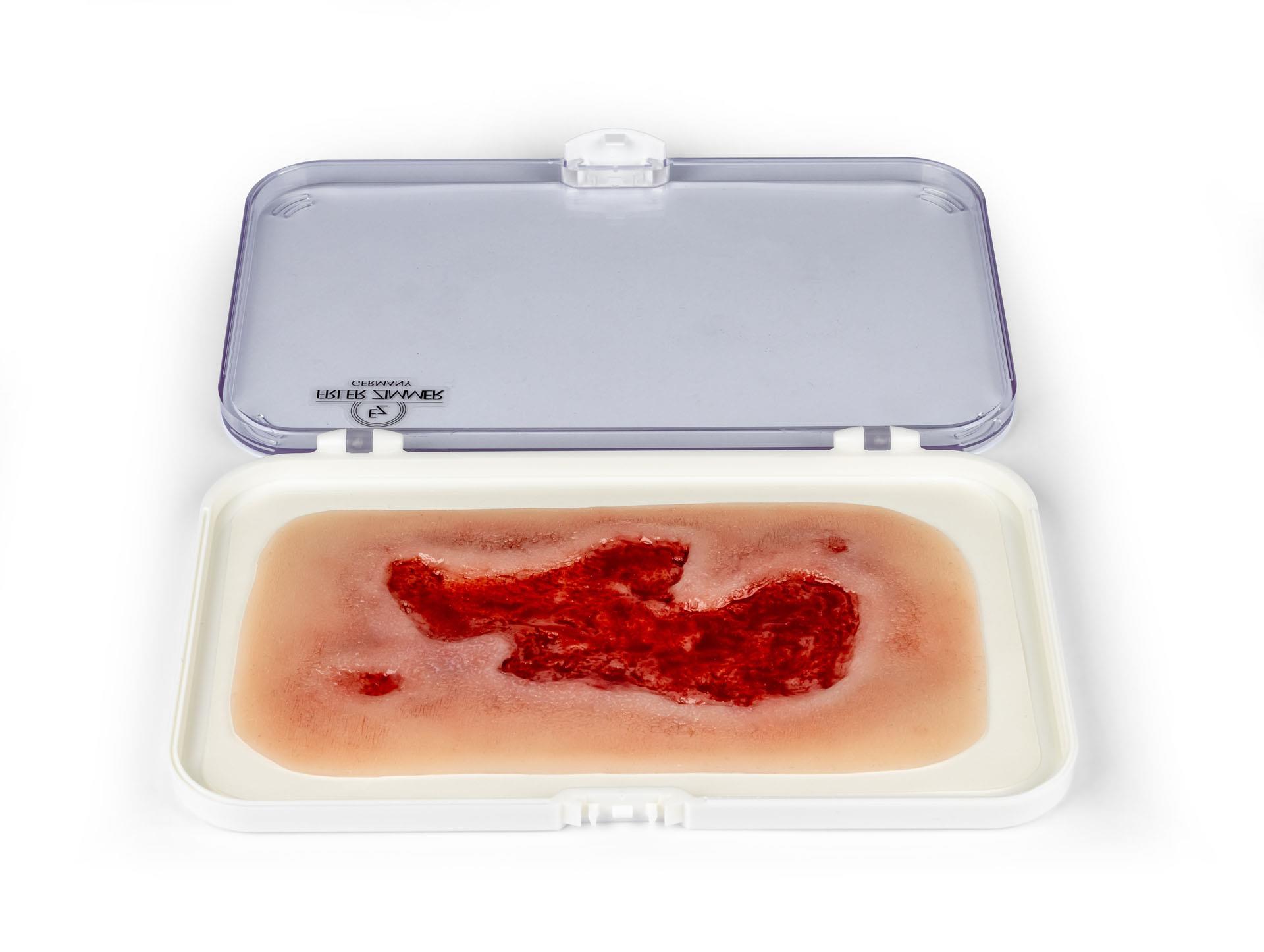
This self-adhesive wound represents a venous leg ulcer, a substance defect in the tissue of the lower leg as a result of a chronic venous insufficiency. The shown granulation phase represents the most common ulcus disease (60% to 80% of all ulcus diseases) in the stage of building granulation tissue. In this stage it is very important to use the suitable dressing to prevent wound healing disorders (fibrin persistence). This small wound is perfect for adhering at the ankle or lower leg and adheres by itself. For longer use, it can be fixed with a special skin glue. All materials used in this product are dermatologically harmless.
Supplied with storage box.
0 of 0 reviews
Leave a review!
Share your experiences with other customers.
Login
No reviews found. Share your insights with others.
This self-adhesive wound represents a venous leg ulcer, a substance defect in the tissue of the lower leg as a result of a chronic venous insufficiency. The shown epithelisation phase represents the most common ulcus disease (60% to 80% of all ulcus diseases) in the stage of building epithelial tissue, finally leading to close the wound. This small wound is perfect for adhering at the ankle or lower leg and adheres by itself. For longer use, it can be fixed with a special skin glue. All materials used in this product are dermatologically harmless.Supplied with storage box.
This self-adhesive wound represents an arterial leg ulcer, a substance defect in the tissue of the lower leg as a result of a peripheral arterial occlusive disease (PAOD). Caused by insufficient blood and related oxygen supply the healing of wounds is inhibited any small injuries can become chronic wounds. This moulage shows the building of epithelial tissue, finally leading to closure of the wound after successful causal therapy and careful wound cleaning.This small wound is perfect for adhering at the ankle or lower leg and adheres by itself. For longer use, it can be fixed with a special skin glue. All materials used in this product are dermatologically harmless.Supplied with storage box.
This self-adhesive wound represents an arterial leg ulcer, a substance defect in the tissue of the lower leg as a result of a peripheral arterial occlusive disease (PAOD). Caused by insufficient blood and related oxygen supply the healing of wounds is inhibited any small injuries can become chronic wounds. In this moulage the necrosis of tissue is represented as extensive black areas. This large wound is perfect for adhering at the lower leg and adheres by itself. For longer use, it can be fixed with a special skin glue. All materials used in this product are dermatologically harmless.Supplied with storage box.
This moulage shows the sacral area with a pressure ulcus after a surgical cleaning. The necrotic tissue has been removed, wound pockets are present. The wound is available either freshly cleaned or with wound exsudate. The moulage can be used for demonstration of vacuum wound therapy. The moulage adheres on simulated patients or manikins, it can be fixed with special skin glue for longer training sessions. The anal fold is represented to demonstrate the typical challenges when dressing the wound.Supplied with storage box.
This self-adhesive wound represents an arterial leg ulcer, a substance defect in the tissue of the lower leg as a result of a peripheral arterial occlusive disease (PAOD). Caused by insufficient blood and related oxygen supply the healing of wounds is inhibited any small injuries can become chronic wounds. This moulage shows the building of epithelial tissue, finally leading to closure of the wound after successful causal therapy and careful wound cleaning.This large wound is perfect for adhering at the lower leg and adheres by itself. For longer use, it can be fixed with a special skin glue. All materials used in this product are dermatologically harmless.Supplied with storage box.
This self-adhesive wound represents a arterial leg ulcer, a substance defect in the tissue of the lower leg as a result of a peripheral arterial occlusive disease (PAOD). Caused by insufficient blood and related oxygen supply the healing of wounds is inhibited any small injuries can become chronic wounds. In this moulage the granulation phase after successful causal therapy and careful wound cleaning is represented. This large wound is perfect for adhering at the lower leg and adheres by itself. For longer use, it can be fixed with a special skin glue. All materials used in this product are dermatologically harmless.Supplied with storage box.
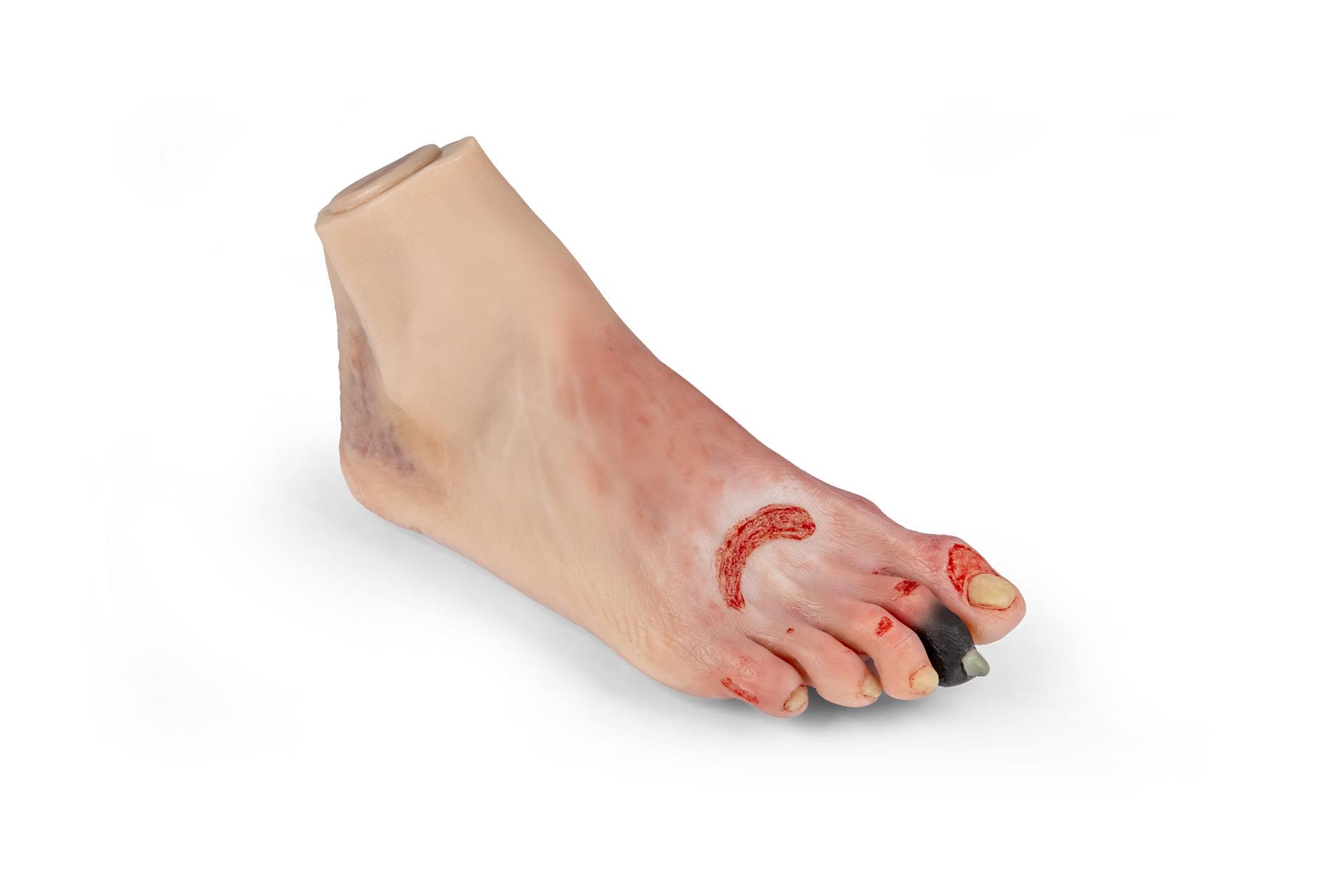
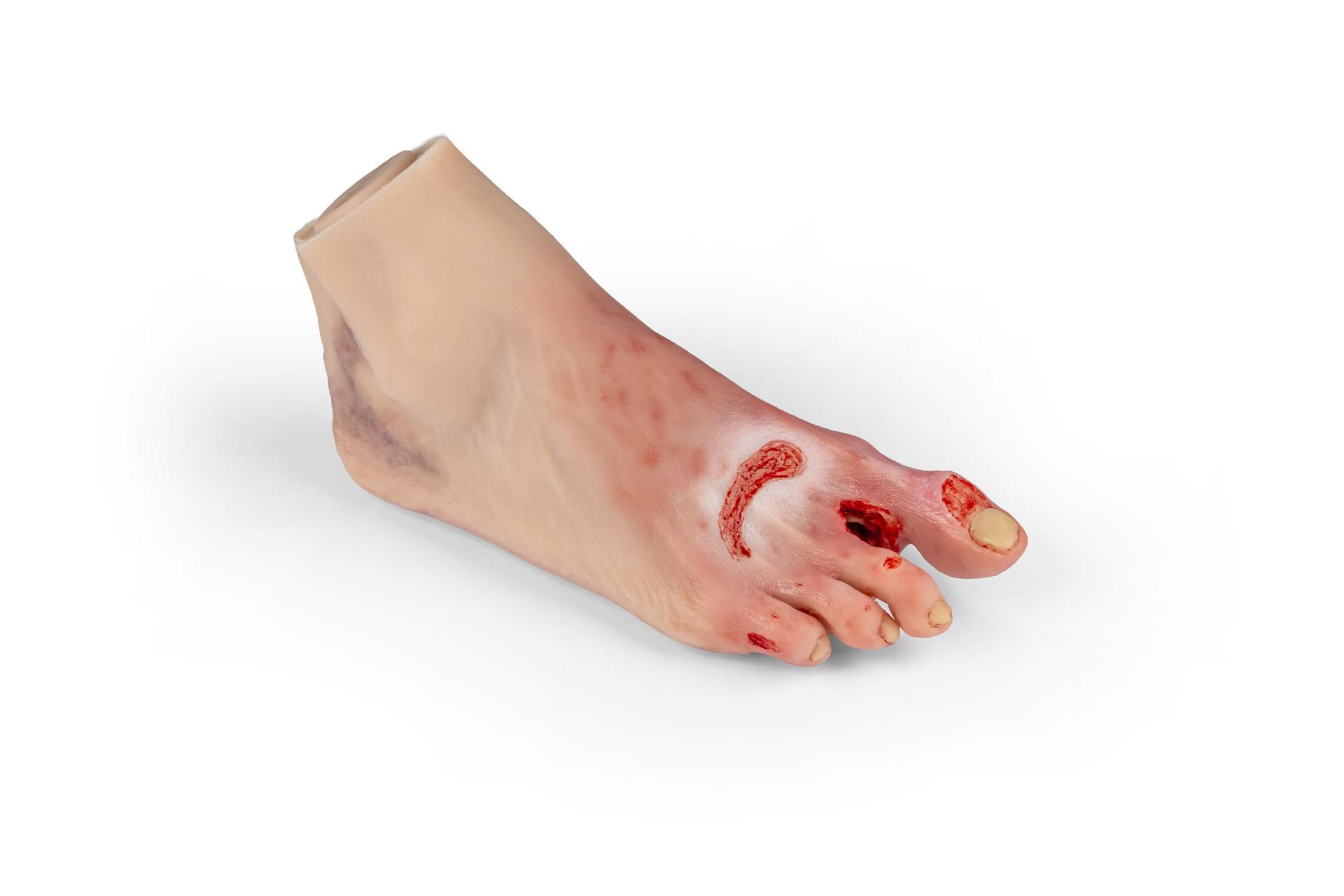
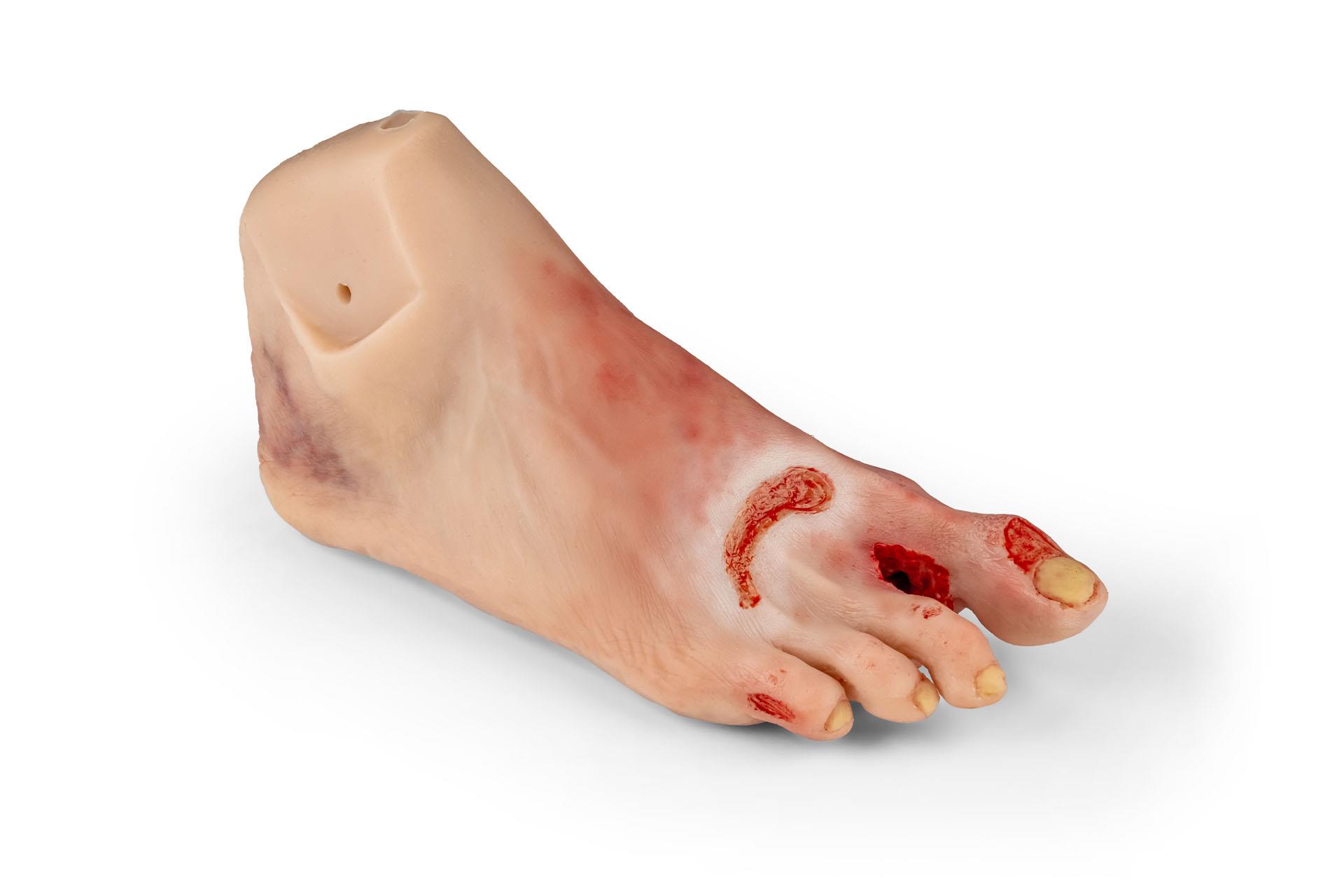
This life-like and life-size foot model shows typical symptoms of the diabetic foot syndrome. Multiple ulcera and lesions are located at typical positions in different grades. Additional symptoms like cracked skin and a necrotic toe are also shown. A perfect model for diabetic education as well as for nursing education or medical studies. Especially suitable for wound care management education.
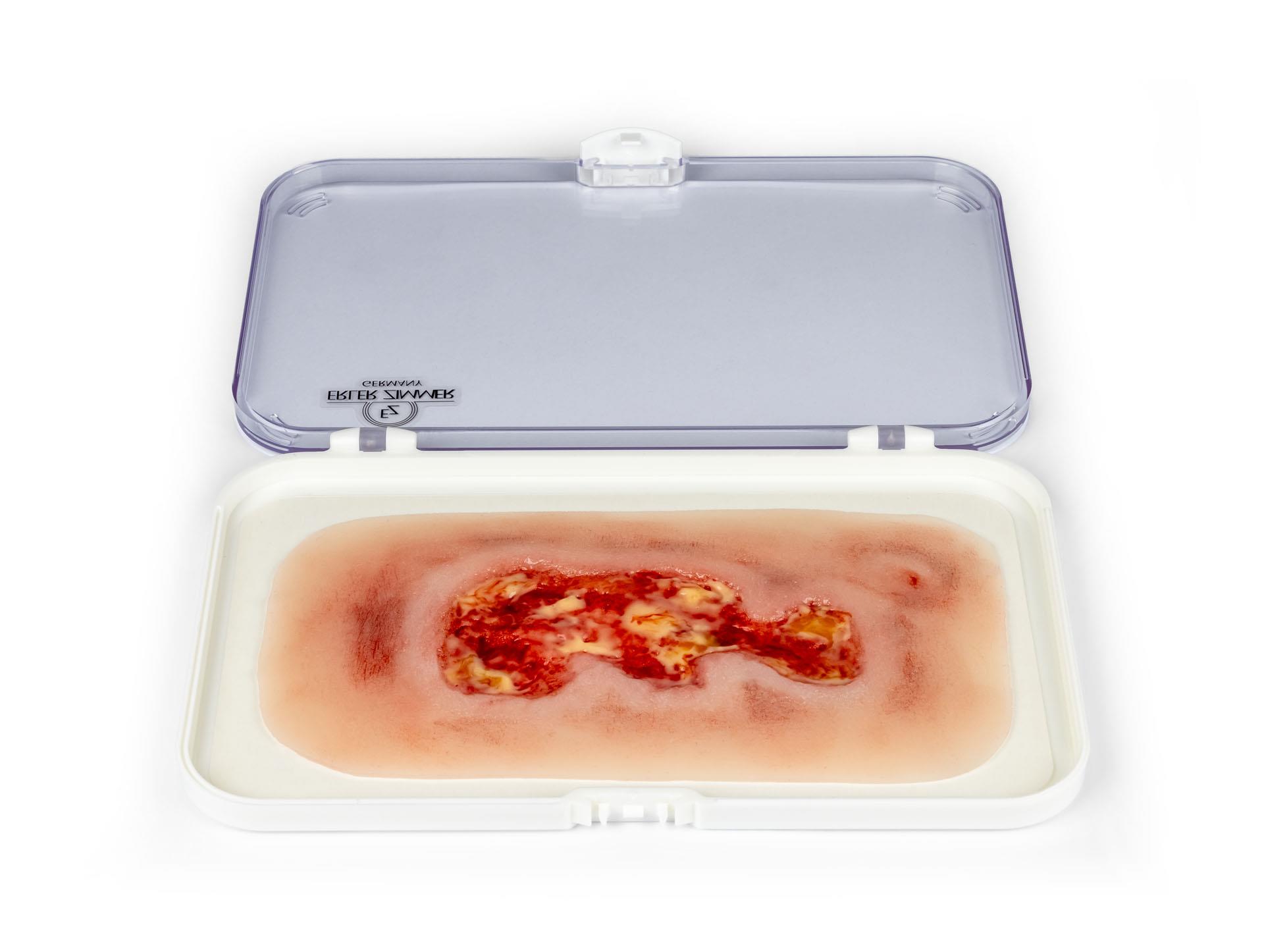
This self-adhesive wound represents a venous leg ulcer, a substance defect in the tissue of the lower leg as a result of a chronic venous insufficiency. The shown exudation phase represents the most common ulcus disease (60% to 80% of all ulcus diseases) in its untreated condition. Fibrin and excessive wound exsudate have to be removed during the would cleaning. This small wound is perfect for adhering at the ankle or lower leg and adheres by itself. For longer use, it can be fixed with a special skin glue. All materials used in this product are dermatologically harmless.Supplied with storage box.
This self-adhesive wound represents a venous leg ulcer, a substance defect in the tissue of the lower leg as a result of a chronic venous insufficiency. The shown exudation phase represents the most common ulcus disease (60% to 80% of all ulcus diseases) in its untreated condition. Fibrin and excessive wound exsudate have to be removed during the would cleaning. This large wound is perfect for adhering at the lower leg and adheres by itself. For longer use, it can be fixed with a special skin glue. All materials used in this product are dermatologically harmless.Supplied with storage box.
This self-adhesive wound represents a venous leg ulcer, a substance defect in the tissue of the lower leg as a result of a chronic venous insufficiency. The shown granulation phase represents the most common ulcus disease (60% to 80% of all ulcus diseases) in the stage of building granulation tissue. In this stage it is very important to use the suitable dressing to prevent wound healing disorders (fibrin persistence). This large wound is perfect for adhering at the lower leg and adheres by itself. For longer use, it can be fixed with a special skin glue. All materials used in this product are dermatologically harmless.Supplied with storage box.
This self-adhesive wound represents a venous leg ulcer, a substance defect in the tissue of the lower leg as a result of a chronic venous insufficiency. The shown epithelisation phase represents the most common ulcus disease (60% to 80% of all ulcus diseases) in the stage of building epithelial tissue, finally leading to close the wound. This large wound is perfect for adhering at the lower leg and adheres by itself. For longer use, it can be fixed with a special skin glue. All materials used in this product are dermatologically harmless.Supplied with storage box.
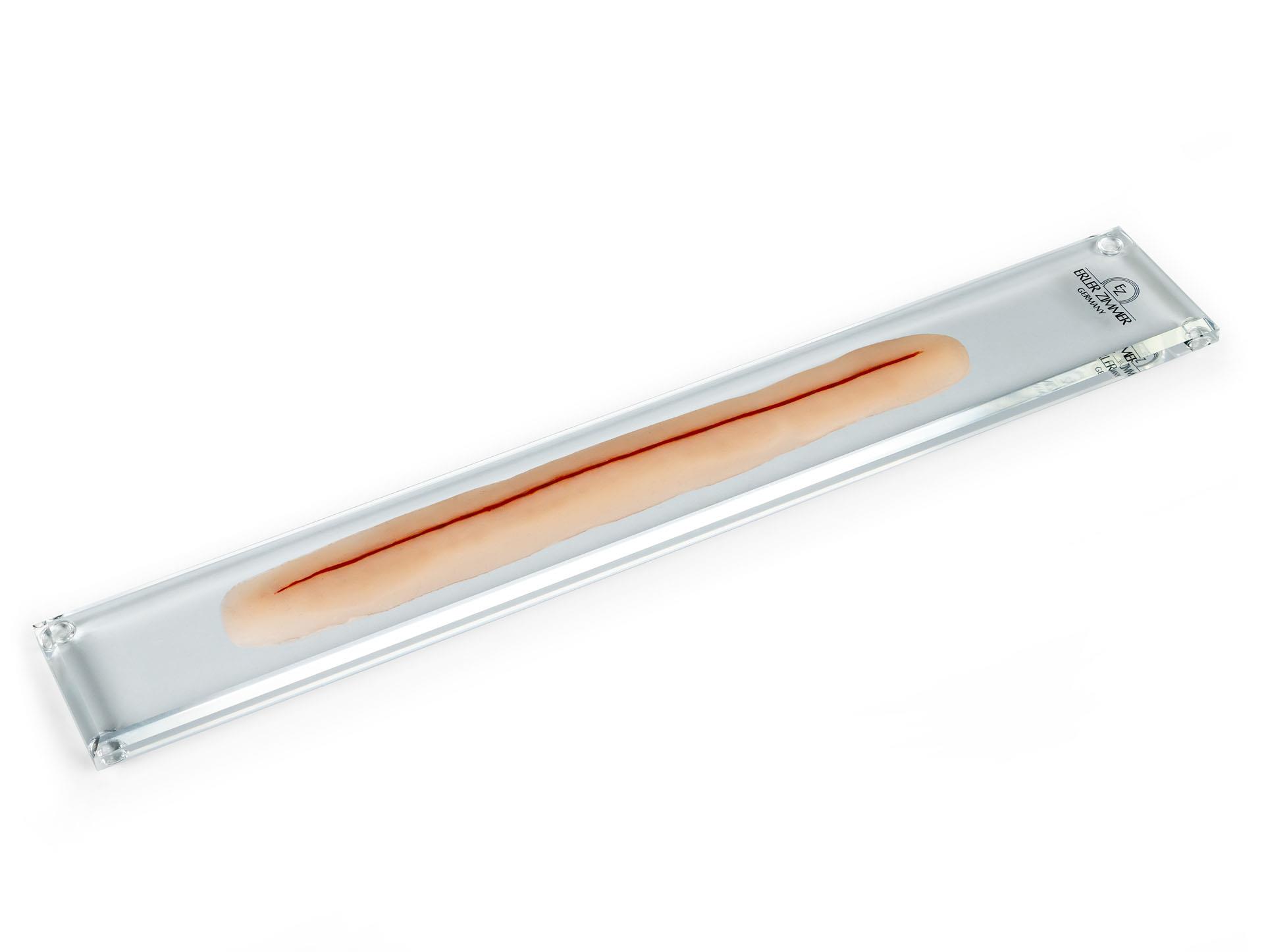
This moulage is made of skin-friendly material and adheres by itself on the skin of a standardized patient, a manikin or on the supplied base. The moulage can be attached to any location of the body, for example over the knee to simulate a wound after a knee replacement or on the belly to simulate a cesarean section. The soft material moves with the body and can be attached over joints. If the moulage does not adhere well anymore, simply clean the backside with alcohol and it will stick strongly again. If the moulage shall be used for a longer course, we recommend a special skin glue.
This self-adhesive wound represents an arterial leg ulcer, a substance defect in the tissue of the lower leg as a result of a peripheral arterial occlusive disease (PAOD). Caused by insufficient blood and related oxygen supply the healing of wounds is inhibited any small injuries can become chronic wounds. In this moulage the necrosis of tissue is represented as extensive black areas. This small wound is perfect for adhering at the ankle or lower leg and adheres by itself. For longer use, it can be fixed with a special skin glue. All materials used in this product are dermatologically harmless.Supplied with storage box.
This self-adhesive wound represents an arterial leg ulcer, a substance defect in the tissue of the lower leg as a result of a peripheral arterial occlusive disease (PAOD). Caused by insufficient blood and related oxygen supply the healing of wounds is inhibited any small injuries can become chronic wounds. In this moulage the granulation phase after successful causal therapy and careful wound cleaning is represented. This small wound is perfect for adhering at the ankle or lower leg and adheres by itself. For longer use, it can be fixed with a special skin glue. All materials used in this product are dermatologically harmless.Supplied with storage box.
This life-size foot model with diabetic foot syndrome shows a foot after a ray resection as a result of necrosis and deep ulcer. Additionally, the foot shows ulcera, lesions and cracked skin. This model is perfect for wound care management education and general nursing education.
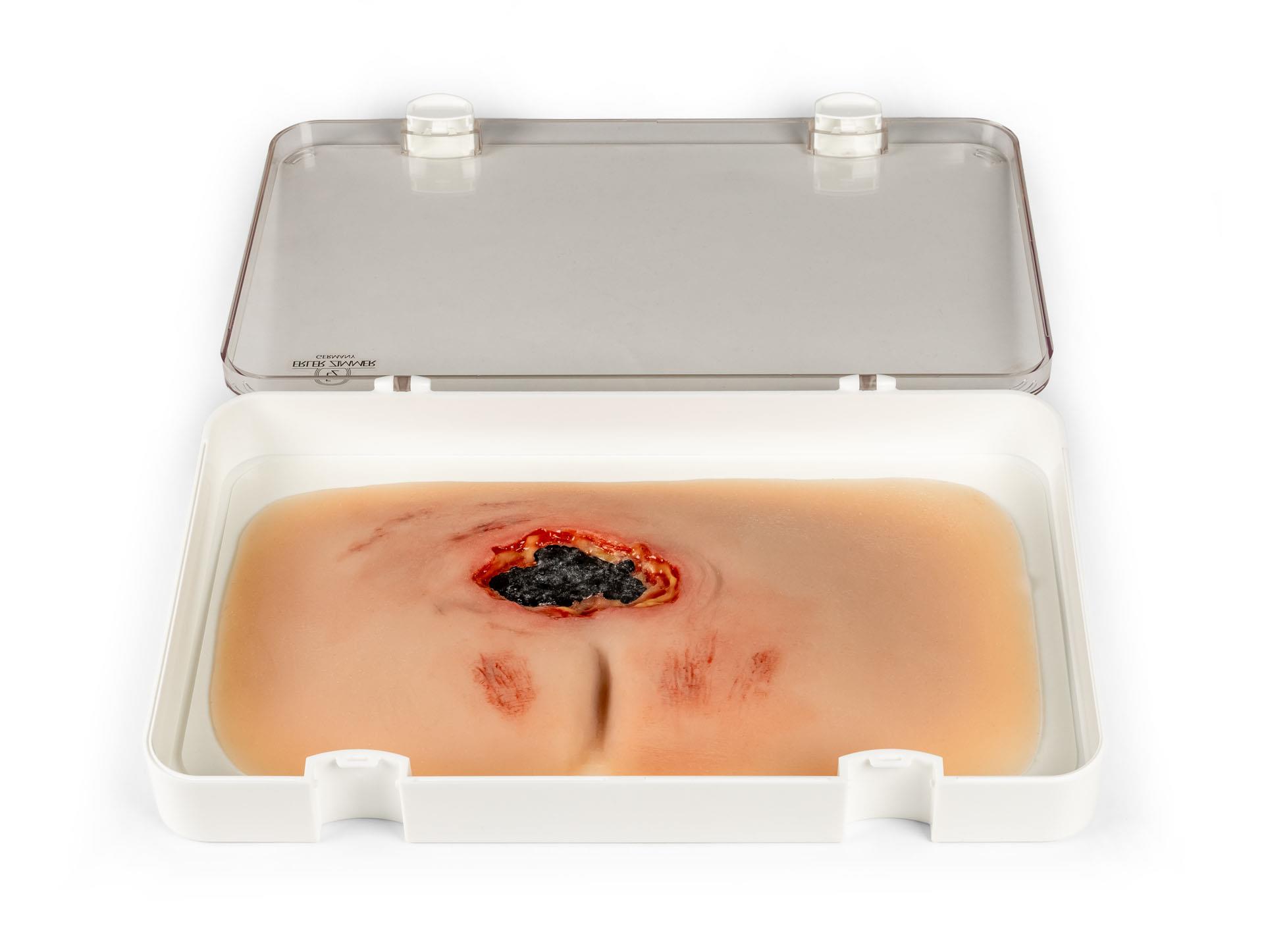
This moulage shows the sacral area with a pressure ulcus in an unattended stage. The tissue has died under continuous pressure and necrotic tissue is visible. The actual size of the necrotic area can not be defined and needs surgical therapy. The moulage adheres on simulated patients or manikins, it can be fixed with special skin glue for longer training sessions. The anal fold is represented to demonstrate the typical challenges when dressing the wound.Supplied with storage box.
This self-adhesive wound represents a venous leg ulcer, a substance defect in the tissue of the lower leg as a result of a chronic venous insufficiency. The shown exudation phase represents the most common ulcus disease (60% to 80% of all ulcus diseases) in its untreated condition. Fibrin and excessive wound exsudate have to be removed during the would cleaning. This small wound is perfect for adhering at the ankle or lower leg and adheres by itself. For longer use, it can be fixed with a special skin glue. All materials used in this product are dermatologically harmless.Supplied with storage box.
This self-adhesive wound represents a venous leg ulcer, a substance defect in the tissue of the lower leg as a result of a chronic venous insufficiency. The shown epithelisation phase represents the most common ulcus disease (60% to 80% of all ulcus diseases) in the stage of building epithelial tissue, finally leading to close the wound. This small wound is perfect for adhering at the ankle or lower leg and adheres by itself. For longer use, it can be fixed with a special skin glue. All materials used in this product are dermatologically harmless.Supplied with storage box.
This self-adhesive wound represents an arterial leg ulcer, a substance defect in the tissue of the lower leg as a result of a peripheral arterial occlusive disease (PAOD). Caused by insufficient blood and related oxygen supply the healing of wounds is inhibited any small injuries can become chronic wounds. In this moulage the necrosis of tissue is represented as extensive black areas. This small wound is perfect for adhering at the ankle or lower leg and adheres by itself. For longer use, it can be fixed with a special skin glue. All materials used in this product are dermatologically harmless.Supplied with storage box.
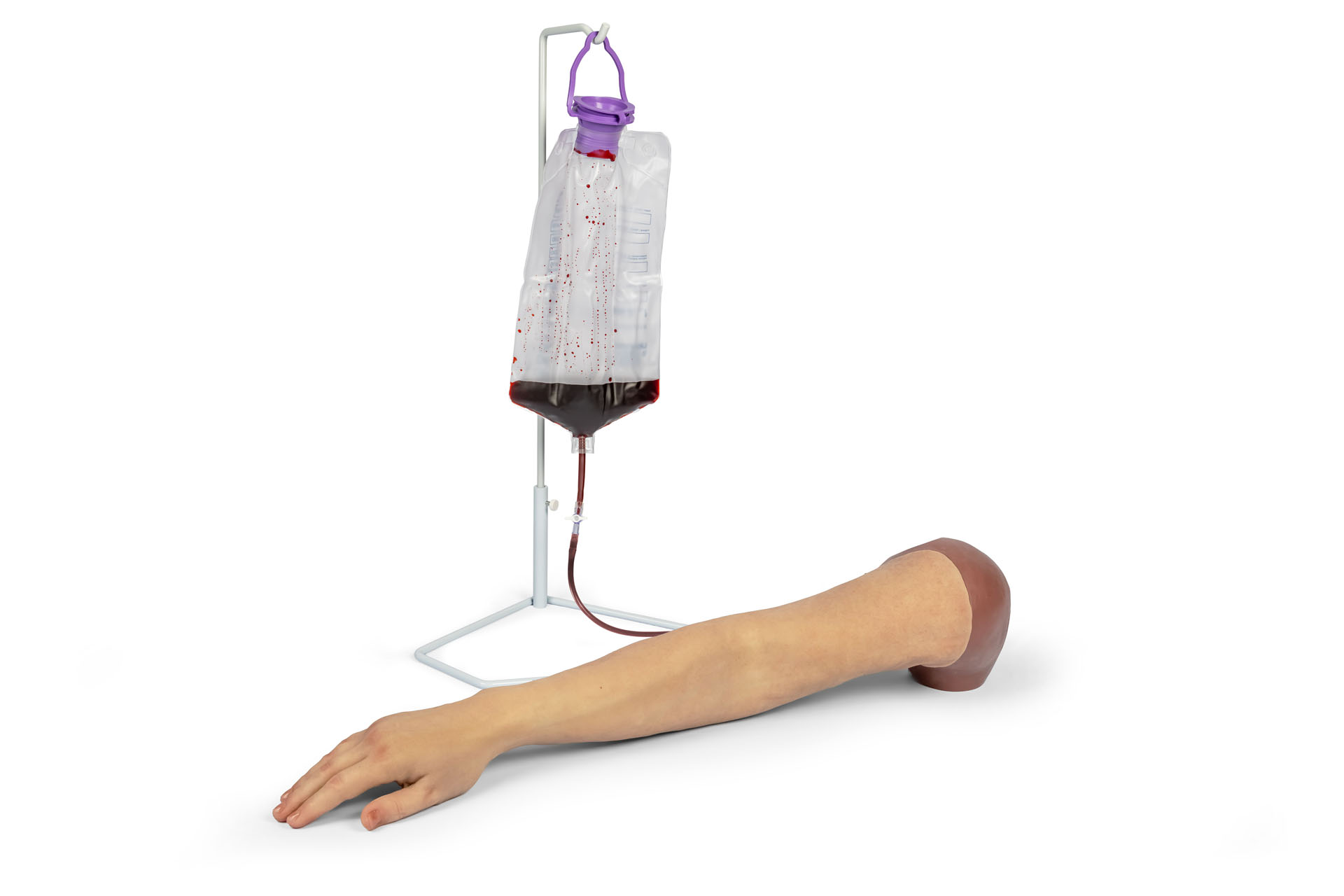
Our new injection training arm „Puncture Pete“ solves all the issues you might have with other arm. It offers a vast network of easily replaceable veins of varying depths, allowing for a range of difficulty levels in IV insertion practice. The following veins can be punctured:- dorsal arch- cephalic vein- basilic vein- brachial (deep) vein- radial vein- median antebrachial vein- ulnar vein- median cubital veinAll veins that can be seen on the skin are exactly under the skin structure and can be punctured. The fluid system is capable of simulating blood flashback upon successful vein puncture, providing immediate feedback to users. The arm is made of durable, yet realistic soft silicone to withstand repeated use and ensure longevity in training environments. It is flexible and allows for adjustable arm positioning and rotation to facilitate varying training scenarios and user preferences. Of course it is compatible with standard IV equipment such as catheters, needles, vacuum tubes, and infusion sets.Advantages:- Skin can be changed easily by one person within some minutes. Simply roll it off and on, making the service for the arm really easy. You will love this arm as it saves you plenty of time.- If you see a vein, you can puncture this vein! We took great lengths to ensure the surface topography corresponds to a “stickable” vessel underneath. In other words, if you can see and palpate a vein, you can stick that vein and achieve blood return.- No more air bubbles in the veins! Air pockets lead to insufficient flashback which can leave a learner thinking they have failed, despite doing everything correctly. Our arms take less than 15 seconds to prime and purge all air bubbles from the system!- Fast and simple vessel installation. Vessels stay put when removing/installing skin! Gone are the days of tubing getting kinked and misaligned. Retention tabs are built-in to the design of the trainer’s core to keep vessels in place during use and maintenance.- Different skin tones – Make your training more realistic by using arms with different skin tones. The truer to life, the more real the experience - the more real the experience, the greater the transfer of knowledge.Scope of delivery:1x Arm, fully assembled, consisting of: - 7710E Arm core for ‘Puncture Pete’ IV training arm - 7710B Veins for ‘Puncture Pete’ IV training arm - 7710C Vein distributor for ‘Puncture Pete’ IV training arm - 7710A Skin for ‘Puncture Pete’ IV training arm, light 1x 7710D Blood bag with supply line1x 7710F Bag for ‘Puncture Pete’ IV training arm1x 7024 Blood-coloured liquidProduct Video
This life-size foot model with diabetic foot syndrome shows a foot after a ray resection as a result of necrosis and deep ulcer. Additionally, the foot shows ulcera, lesions and cracked skin. This model is perfect for wound care management education and general nursing education.Version for attachement to nursing manikins
This moulage shows the sacral area with a pressure ulcus in an unattended stage. The tissue has died under continuous pressure and necrotic tissue is visible. The actual size of the necrotic area can not be defined and needs surgical therapy. The moulage adheres on simulated patients or manikins, it can be fixed with special skin glue for longer training sessions. The anal fold is represented to demonstrate the typical challenges when dressing the wound.Supplied with storage box.