













Partial Body
2
Products
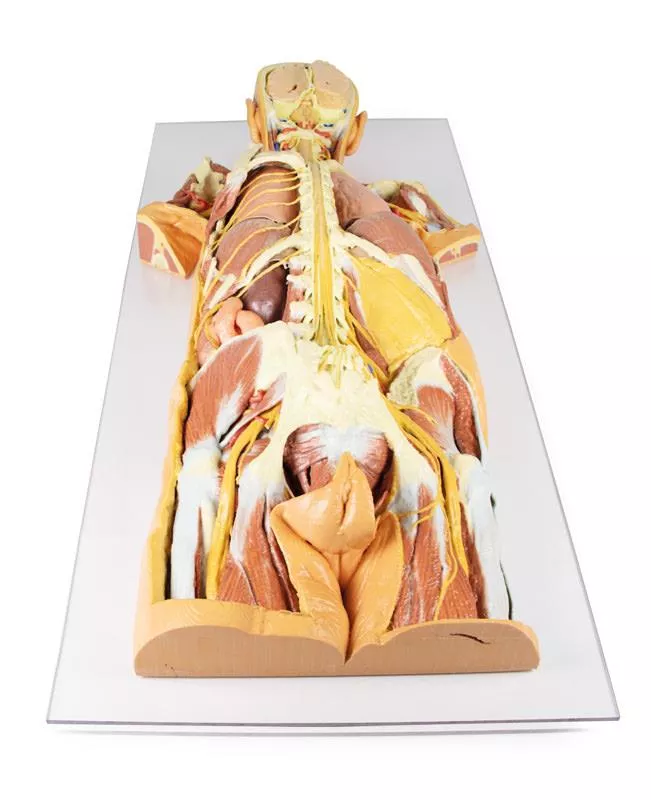
Nervous System Dissection (posterior view)
This detailed 3D printed specimen provides a unique dorsal view of the head, neck, thorax, abdomen, and gluteal regions, highlighting the central nervous system and segmental nerves in anatomical context. The model reveals deep structures through extensive removal of posterior elements, including the posterior cranium, vertebral arches, and parts of the thoracic and gluteal walls.Cranial and Cervical StructuresThe posterior skull is removed to display a coronal section of the cerebral hemispheres, separated by the falx cerebri and bordered by a preserved superior sagittal sinus. The cerebellum is removed, exposing the fourth ventricle, pons, medulla oblongata, and cranial nerves VII–XII. The vertebral arteries are visible ascending through the transverse foramina and curving toward the foramen magnum. The cervical and brachial plexus roots are shown resting on scalene muscles and major vessels, extending into the axilla. Axilla and Upper ThoraxThe scapulae are partially (left) or fully (right) removed, allowing visualization of the brachial plexus and axillary vessels.On the left, parts of deltoid, infraspinatus, and teres minor remain, while the long thoracic nerve, lateral thoracic artery, and subscapular branches are preserved.On the right, the axillary nerve and posterior circumflex humeral artery are shown passing toward the surgical neck of the humerus. Thoracic Spine and Intercostal NervesA laminectomy reveals the spinal cord, dorsal roots, and ganglia.On the right, the posterior thoracic wall is removed (ribs 2–12), exposing the lung and diaphragm.On the left, ribs 3–5 are retained to show intercostal musculature and nerve positioning, with the full set of intercostal nerves preserved.Lumbar Region and AbdomenThe lumbar spinal cord is opened to show the conus medullaris and cauda equina.On the right, the quadratus lumborum is removed, exposing subcostal and lumbar nerves along the psoas.On the left, the subcostal nerve, kidney, and jejunum are visible through an opened peritoneal cavity. Gluteal and Pelvic DissectionIn the gluteal region, gluteus maximus is removed bilaterally:Left side: Gluteus medius is preserved; the superior and inferior gluteal arteries and nerves, internal pudendal vessels, and the sciatic nerve are visible relative to the piriformis and lateral rotators.Right side: Deeper dissection reveals the lumbar and sacral plexuses within the true pelvis. This model offers a rare, continuous view of deep axial anatomy, perfect for advanced anatomical study, neuroanatomy training, and surgical reference.
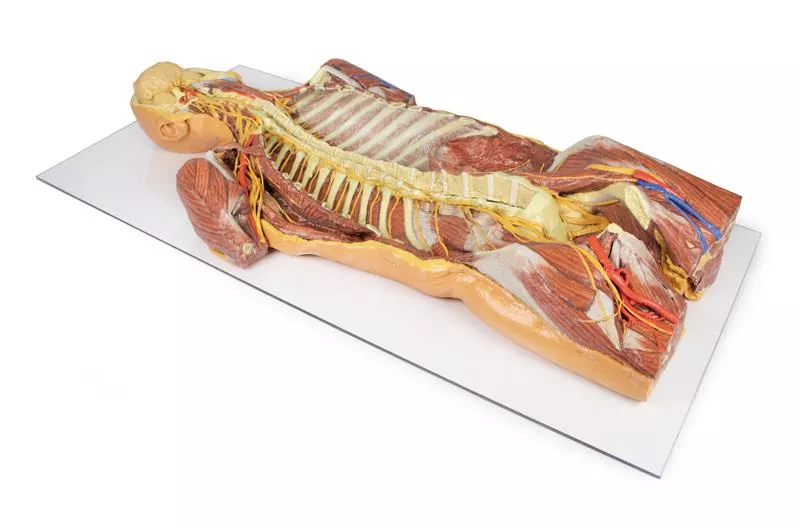
Posterior Body Wall / Ventral Deep Dissection
This 3D printed model provides a detailed ventral view of the head, neck, thorax, abdomen, and proximal thighs, offering insight into the central nervous system, nerve plexuses, and major vascular structures. It serves as a complementary piece to the dorsal dissection model (MP1400).Brain and Upper SpineThe facial skeleton is removed, exposing both cerebral hemispheres, parts of the Circle of Willis, and key arteries (vertebral, basilar, AICA, labyrinthine). Several cranial nerves (II, III, V, VI) and the right internal carotid artery are preserved. Below, the anterior spinal cord, vertebral arteries, and cervical and brachial plexus roots are visible, along with CN X, CN XII, and the sympathetic trunks. Axillae and Upper LimbsThe anterior thoracic wall, clavicles, and first ribs are removed to expose both axillae, with clear views of the brachial plexus, axillary arteries, and surrounding musculature. The proximal upper limbs are preserved to mid-arm level. Thorax and Lumbar RegionThe spinal cord extends to the conus medullaris, with ventral nerve roots and sympathetic chains visible throughout. Splanchnic nerves, intercostal nerves, and abdominal wall nerves (e.g., ilioinguinal, genitofemoral, femoral) are preserved. On the right, removal of the psoas muscle exposes the lumbar plexus.Pelvis and Proximal ThighThe pelvic viscera are removed, but the pelvic floor, rectum, and lumbosacral plexus remain. Obturator nerves are visible entering the obturator canals, and the femoral vessels are retained in both femoral triangles. This model is ideal for studying ventral CNS access, neurovascular pathways, and regional anatomical relationships across the entire torso.
Human body replicas to improve teaching!
Erler-Zimmer's groundbreaking Anatomy Series features a unique and unrivalled collection of colourised human body replicas specifically designed to enhance teaching and learning. This premium collection of highly accurate human anatomy has been created directly from radiological data or real specimens using the latest imaging techniques. The 3D Human Anatomy Series offers a cost-effective way to meet your specific teaching and demonstration needs across the curriculum in medicine, health sciences and biology. A detailed description of the anatomy represented in each 3D printed specimen is included. What are the advantages of the Monash 3D Anatomy Series compared to plastic models or real human plastinates?
Each body replica has been carefully developed from selected radiological patient data or dissected human bodies of the highest quality, chosen by a highly skilled team of anatomists at Monash University's Human Anatomy Teaching Centre, to represent clinically important areas of anatomy in a quality and detail not possible with conventional models - it is real anatomy, not stylised. Each body replica has been rigorously checked by the highly qualified team of anatomists at Monash University's Human Anatomy Teaching Centre to ensure the anatomical accuracy of the final product. The body replicas are not real human tissue and are therefore not subject to any restrictions on transport, import or use in educational institutions that do not have permission to use cadavers. The
exclusive 3D Anatomy Series avoids these and other ethical issues that arise when dealing with plastinated human remains.