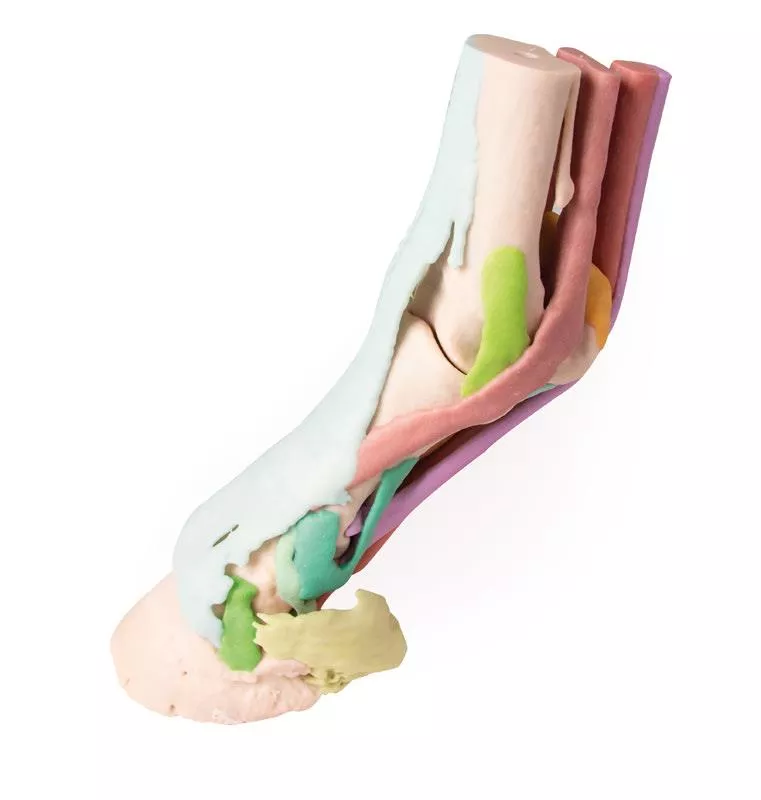
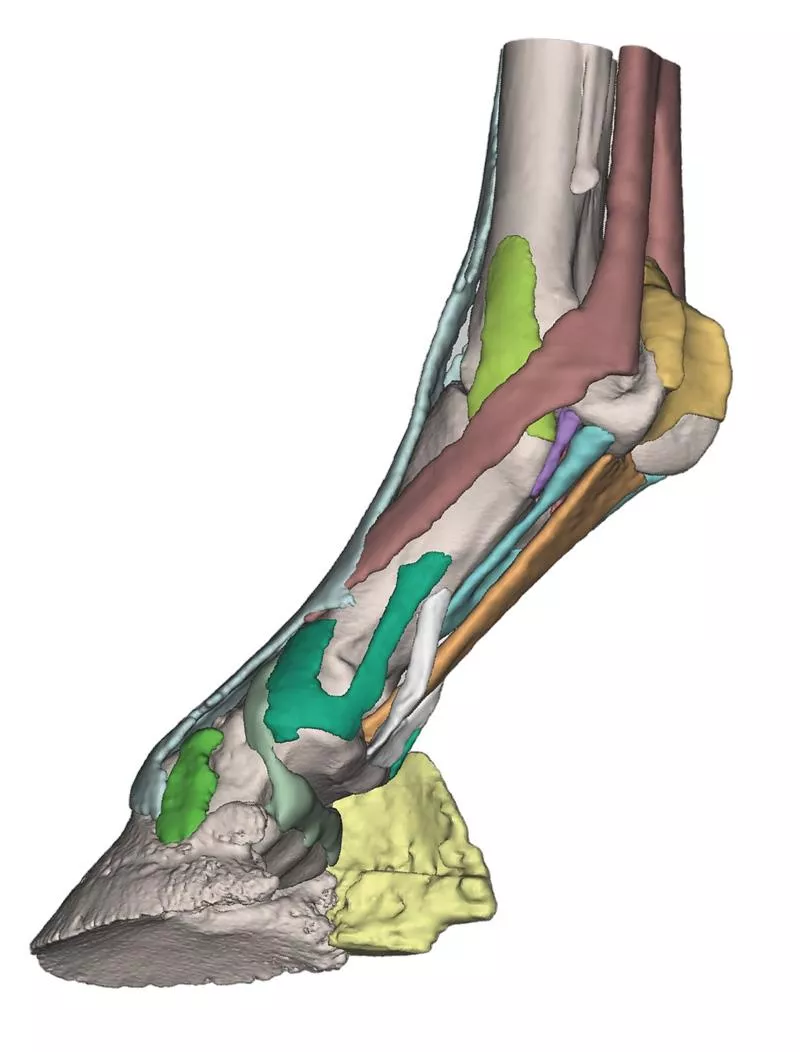
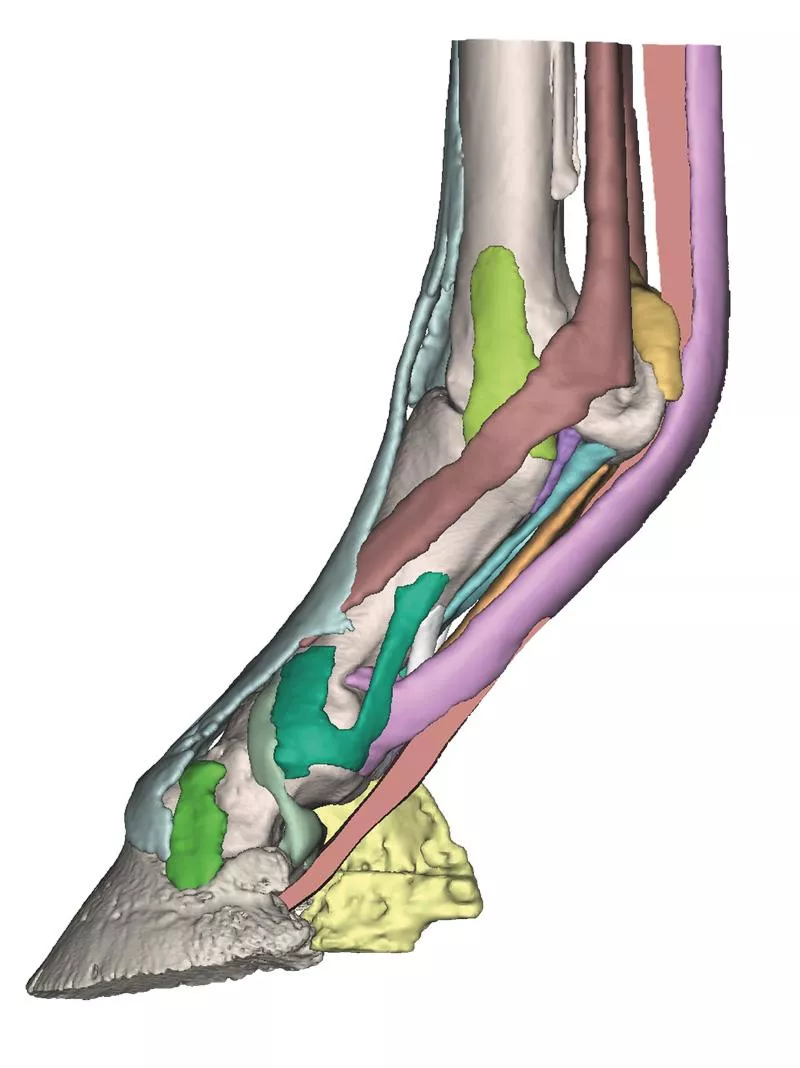
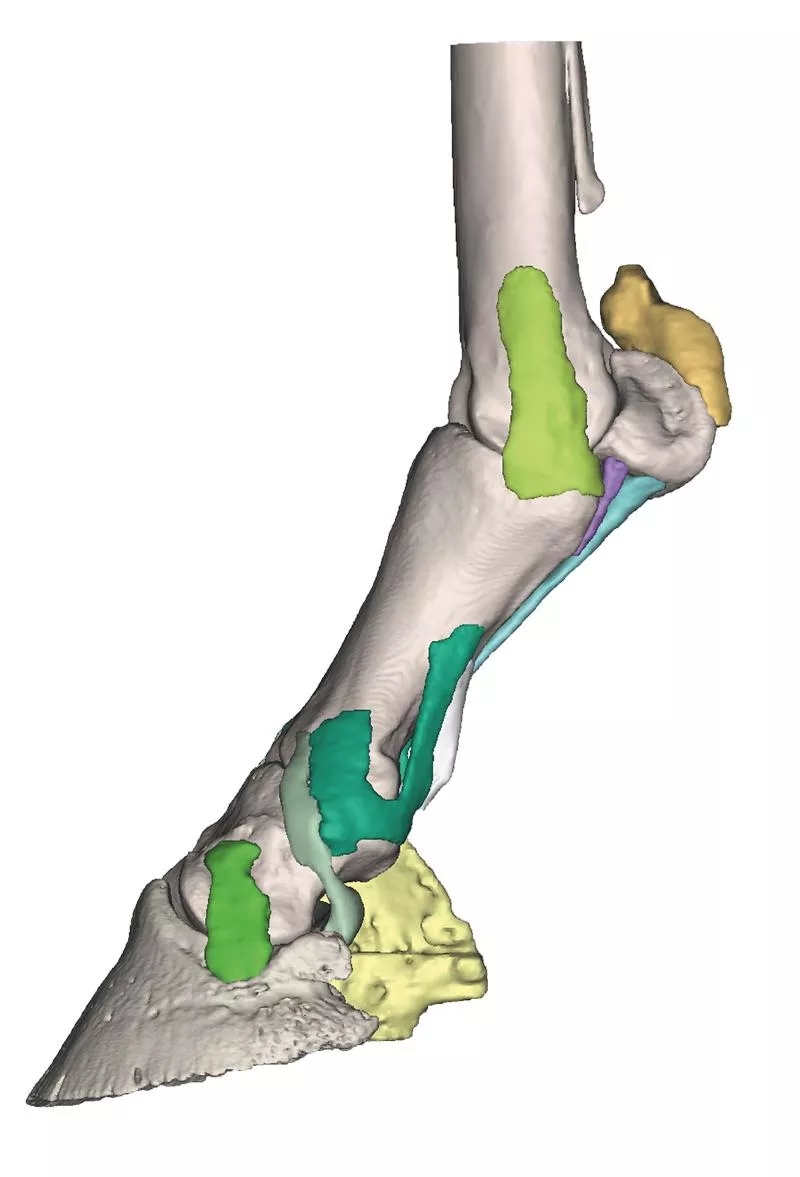
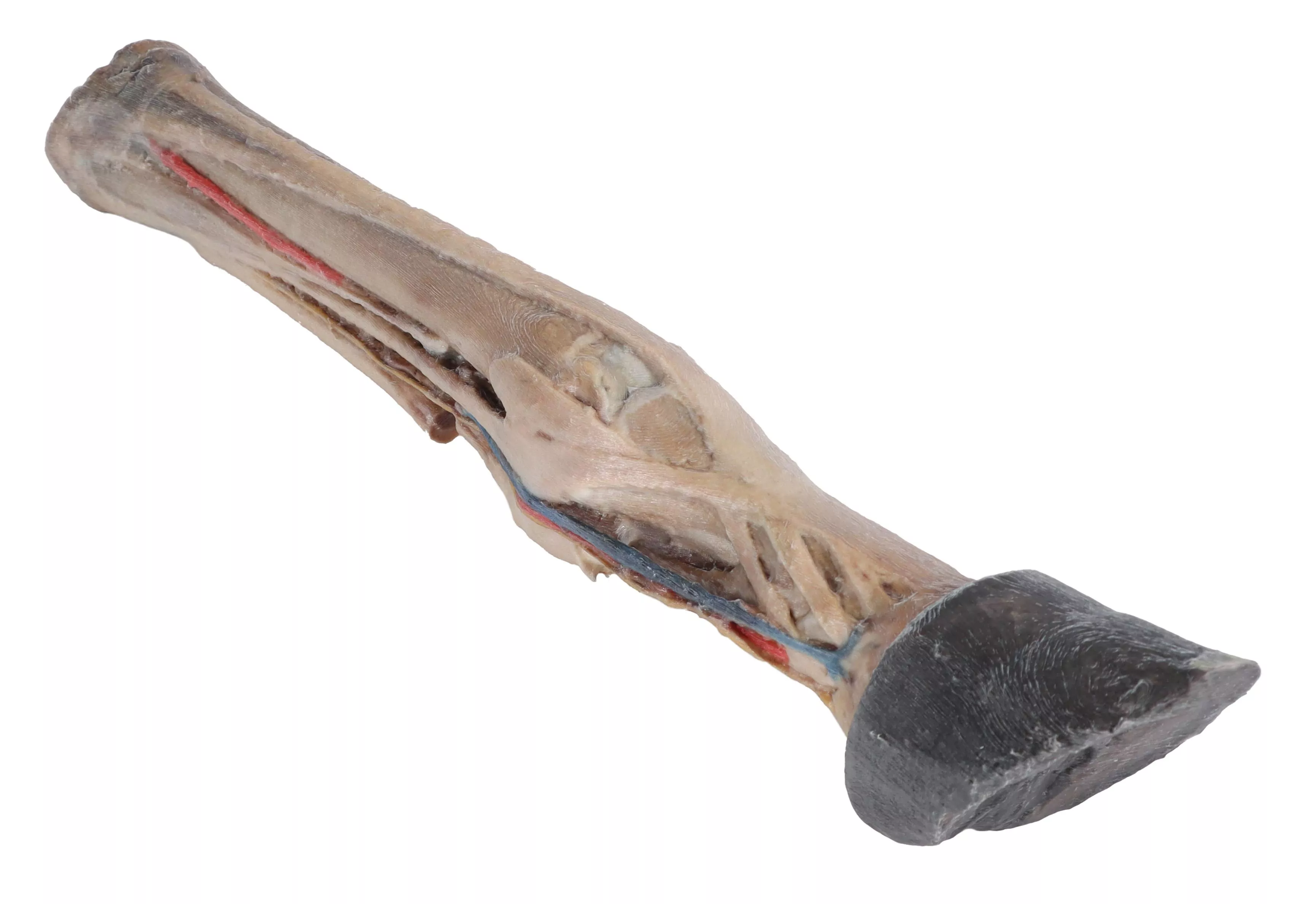
Derived from CT and MR co-registered data, anatomically accurate and lifesize. 3D printed in full color, each anatomical component is individually colored. Hoof capsule is available separately and anchors the distal limb in the stance position. The series consists of four models: starting from Model 1 showing the full anatomy of the foot and comprised of 25 anatomical structures to step-by-step reduced models showing deeper structures.Model 1:Structures: Third metacarpal bone; Proximal sesamoid bones; Proximal phalanx; Middle phalanx; Distal phalanx; Distal sesamoid (navicular) bone; Ungular cartilages; Collateral ligaments of the metacarpophalangeal joint; Collateral ligaments of the proximal interphalangeal joint and the abaxial palmar ligaments of the foot; Collateral ligaments of the distal interphalangeal joint; Collateral ligament of the distal sesamoid (navicular) bone; Distal sesamoidean impar ligament; Proximal scutum and intersesamoidean ligament; Cruciate sesamoidean ligament; Short sesamoidean ligaments; Oblique sesamoidean ligaments; Straight sesamoidean ligament; Axial palmar ligaments of the foot; Suspensory ligament and extensor branches; Deep digital flexor tendon; Superficial digital flexor tendon; Common digital extensor tendon.
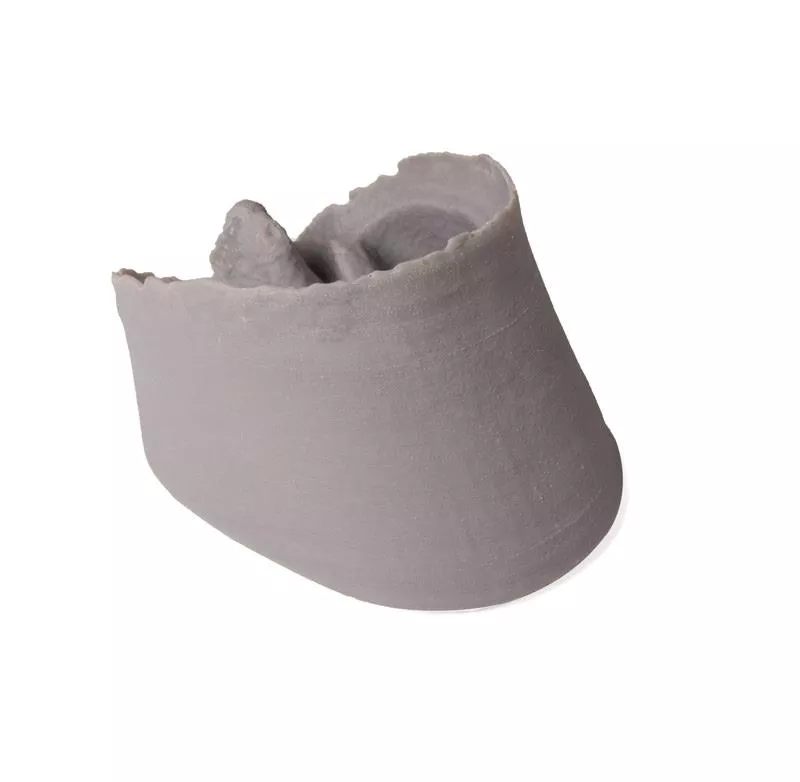
Derived from CT and MR co-registered data, anatomically accurate and lifesize. 3D printed in full color, each anatomical component is individually colored. Hoof capsule is available separately and anchors the distal limb in the stance position. The series consists of four models: starting from Model 1 showing the full anatomy of the foot and comprised of 25 anatomical structures to step-by-step reduced models showing deeper structures.Hoof Capsule:The corresponding hoof capsule is separate and anchors the distal limb in the stance position.Suitable for: VET4400, VET4410, VET4420 and VET4430.
Derived from CT and MR co-registered data, anatomically accurate and lifesize. 3D printed in full color, each anatomical component is individually colored. Hoof capsule is available separately and anchors the distal limb in the stance position. The series consists of four models: starting from Model 1 showing the full anatomy of the foot and comprised of 25 anatomical structures to step-by-step reduced models showing deeper structures.Model 2:As Model 1, however, this model shows the proximal sesamoidean ligaments, impar ligament and the collateral ligaments of the distal sesamoid(navicular) bone.
Derived from CT and MR co-registered data, anatomically accurate and lifesize. 3D printed in full color, each anatomical component is individually colored. Hoof capsule is available separately and anchors the distal limb in the stance position. The series consists of four models: starting from Model 1 showing the full anatomy of the foot and comprised of 25 anatomical structures to step-by-step reduced models showing deeper structures.Model 3:Similar to Model 1, but this model, with the deep digital flexor tendon sectioned, shows the tendon’s relationship to the distal sesamoid bone and the impar ligament. One ungular cartilage is absent to show the collateral ligaments of the distal sesamoid bone.
Derived from CT and MR co-registered data, anatomically accurate and lifesize. 3D printed in full color, each anatomical component is individually colored. Hoof capsule is available separately and anchors the distal limb in the stance position. The series consists of four models: starting from Model 1 showing the full anatomy of the foot and comprised of 25 anatomical structures to step-by-step reduced models showing deeper structures.Model 4:This model, stripped of tendons and the suspensory ligament, shows the bones of the foot and their deep supporting ligaments.
This horse half-head shows a superficial dissection on the right lateral aspect and a middle sagittal section on the medial aspect.On the lateral side the skin has been removed, except on the nostrils, lips and external ear. In the rostral part of the dissection are the muscles of facial mimicry, the levator nasolabialis, canine, levator labii superioris, zygomaticus, buccinator (buccal portion) and depressor labii inferioris muscles. The caudal part of the dissection is occupied by the masseteric muscle covered by the masseteric fascia from the facial crest of the maxillary bone. This muscle presents on the surface the course of the dorsal and ventral buccal branches of the facial nerve, which end rostrally as buccolabial branches. In the notch of the facial vessels, the facial artery and vein are located together with the parotid duct. In the dorsal and caudal part of the masseter muscle, the transverse facial artery and vein are located together with the auriculotemporal nerve. The parotid-auricular muscle, the parotid gland, and the maxillary and linguofacial veins are located in the cervicofacial transit.In the middle sagittal section, the nasal cavity is occupied by the ventral nasal concha, dorsal nasal concha, and middle nasal concha, separated by the dorsal, middle, and ventral nasal meatuses. The perpendicular lamina of the ethmoid bone is located in the caudal area of the nasal cavity. This bone is the rostral limit of the cerebral fossa. The cerebellar fossa is caudal to the anterior one. The vomer bone establishes the choanae as transit to the nasopharynx where the pharyngeal opening of the auditory tube is located. The oral cavity is limited dorsally by the hard palate, which continues caudally as the soft palate. The sagittal section of the tongue shows the proper lingual muscle as well as the genioglossus and genihyoid muscles. The oropharynx is occupied by the root of the tongue and the soft palate. The epiglottis, arytenoid cartilage, and cricoid cartilage limit the laryngeal cavity with the lateral ventricle, vocal fold, and infraglottic cavity. The laryngopharynx is occupied by the esophageal vestibule. The esophagus is located dorsal to the trachea and ventral to the long cervical and long capitis muscles. The mandibular lymph nodes are in the intermandibular space.
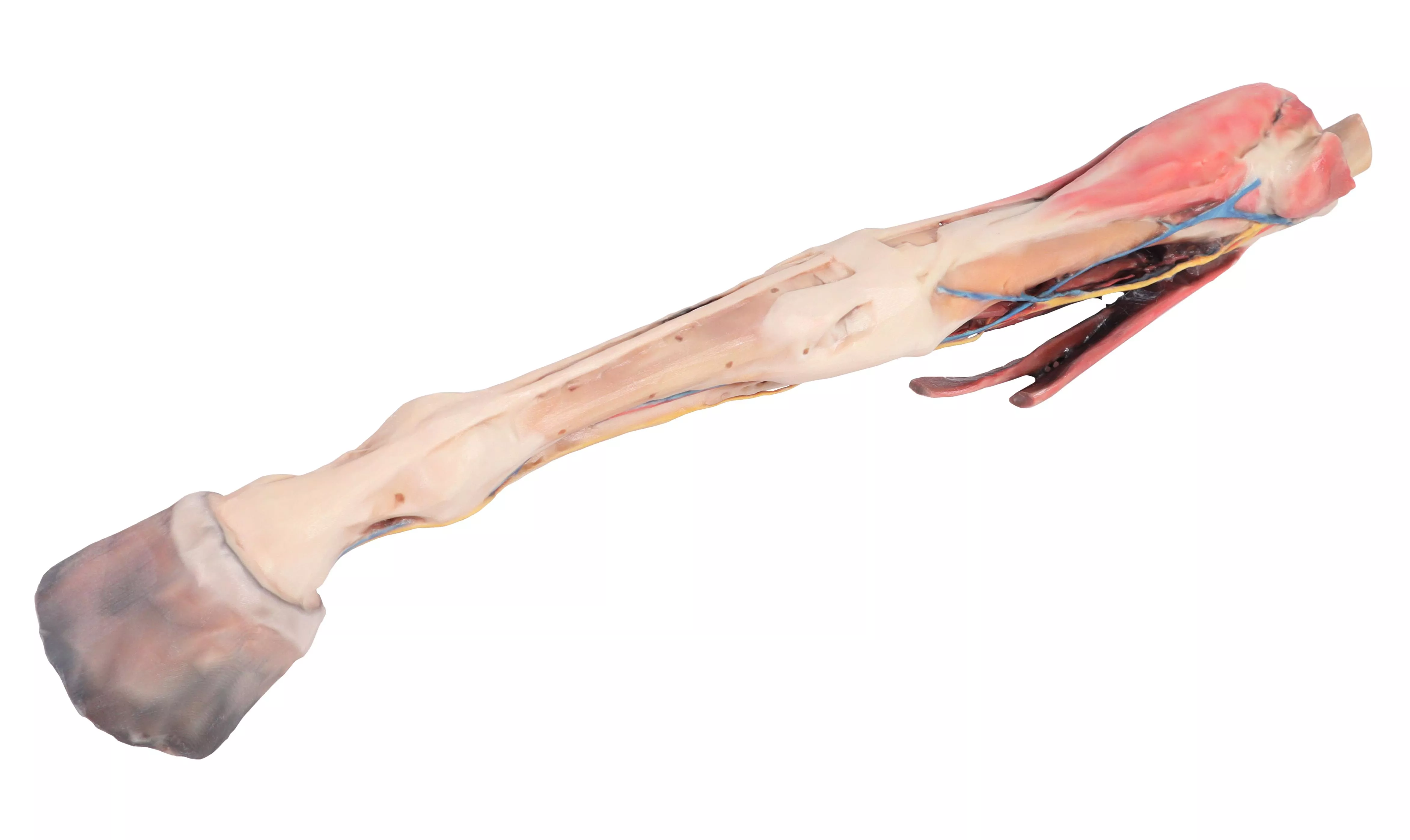
This specimen demonstrates the superficial anatomy of a right forelimb from the elbow joint to the hoof. The carpus and digital extensor and flexor muscles are located in the forearm related to the pathway of the median and cubital nerves. The main branches of the median artery as well as the median and cephalic veins have been maintained. Distal to the carpus the specimen shows the topographic relation of the palmar nerves with the digital tendon flexors. Distal to the metacarpophalangeal joint it is possible to see at both sides the palmar digital neurovascular bundle.
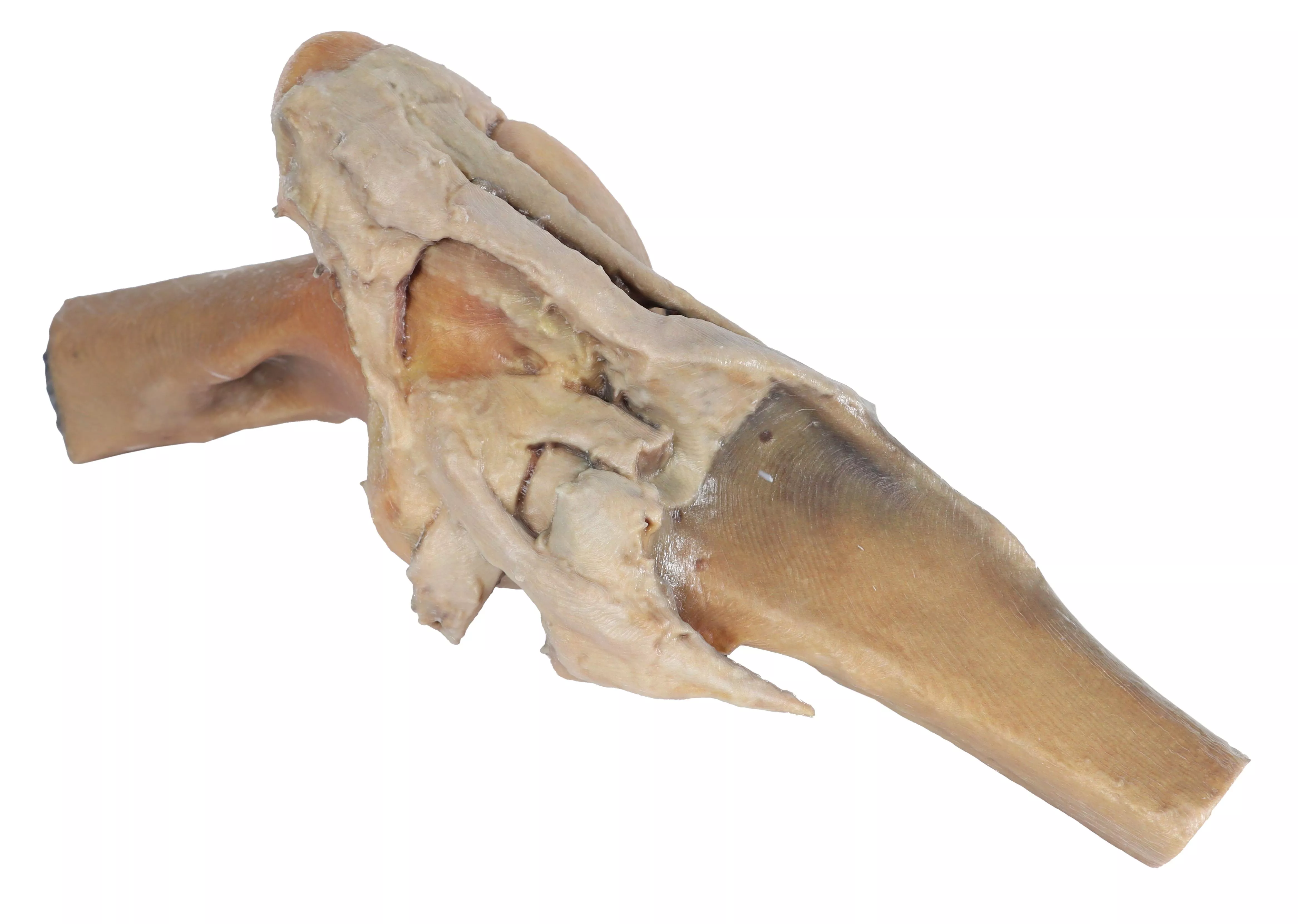
This specimen demonstrates the ligaments of the stifle joint with the leg in extension. In the anterior view, with the patella and the three patellar ligaments.The medial and lateral menisci, the caudal cruciate, the femoropatellar and the collateral ligaments are visible.
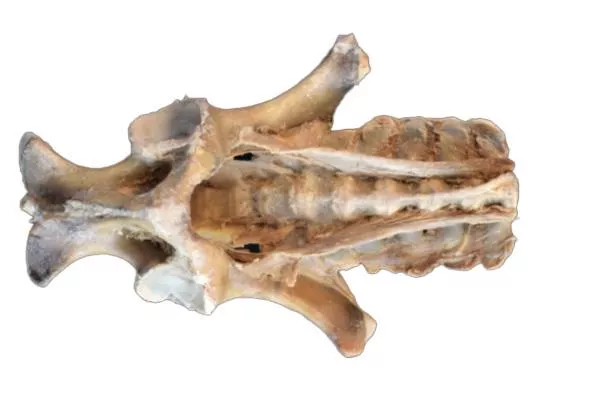
This specimen is focused on the sacroiliac joint, the two coxal bones (os coxae) are exposed in the dissection: Ilium, pubis and ischium, together with lumbar vertebrae and sacrum. At the sacroiliac joint, the dorsal sacroiliac ligament can be identified. The broad sacrotuberous ligament of the pelvis extends from the lateral sacral crest to the sciaticspine and ischial tuberosity. The greater sciatic foramen occupied by the lumbosacral trunk. From the vertebral bodies and part of the transverse processes of the lumbarvertebrae, the tendons of insertion of the psoas minor muscles are identified. The ventral longitudinal ligament connects the ventral aspect of most cranial lumbar vertebral bodies.
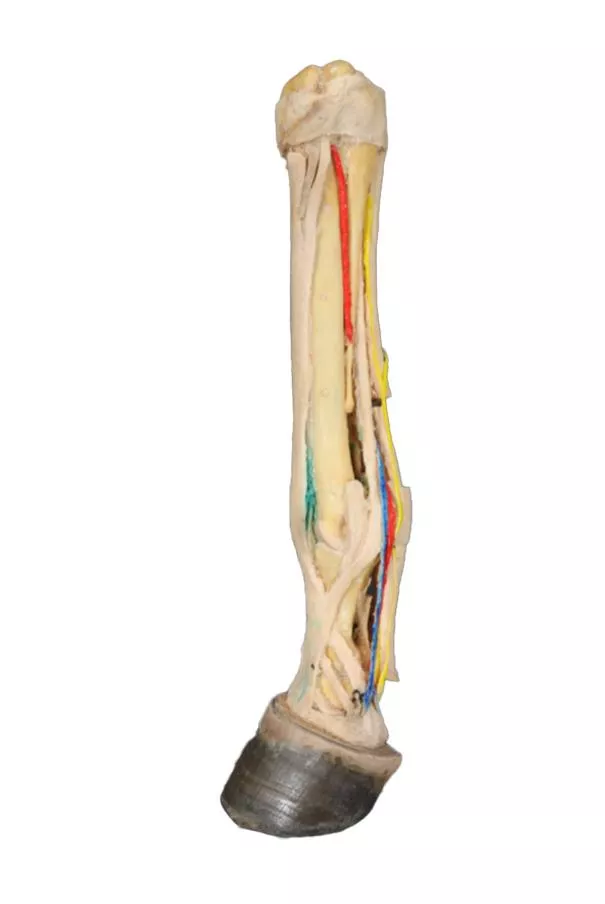
This dissected right-foot specimen displays a mixture of the vascular, nervous, ligaments and tendons. The plantar digital neurovascular bundles both sides of the flexor tendons. The two digital extensor tendons are identified in the proximal dorsal aspect of the specimen. Metatarsophalangeal and proximal interphalangeal joints show all ligaments. Between the plantar aspect of the metatarsal bones and the digital tendon flexors is the interosseus ligament with its sesamoid and extensor branches.
This dissected left-foot specimen displays the plantar digital neurovascular bundle both sides of the flexor tendons. The two digital extensor tendons are identified in the dorsal aspect of the specimen. The plantar aspect of the metacarpophalangeal and proximal interphalangeal joints show a dissection of the deep ligaments and their relationship with the neurovascular bundle.
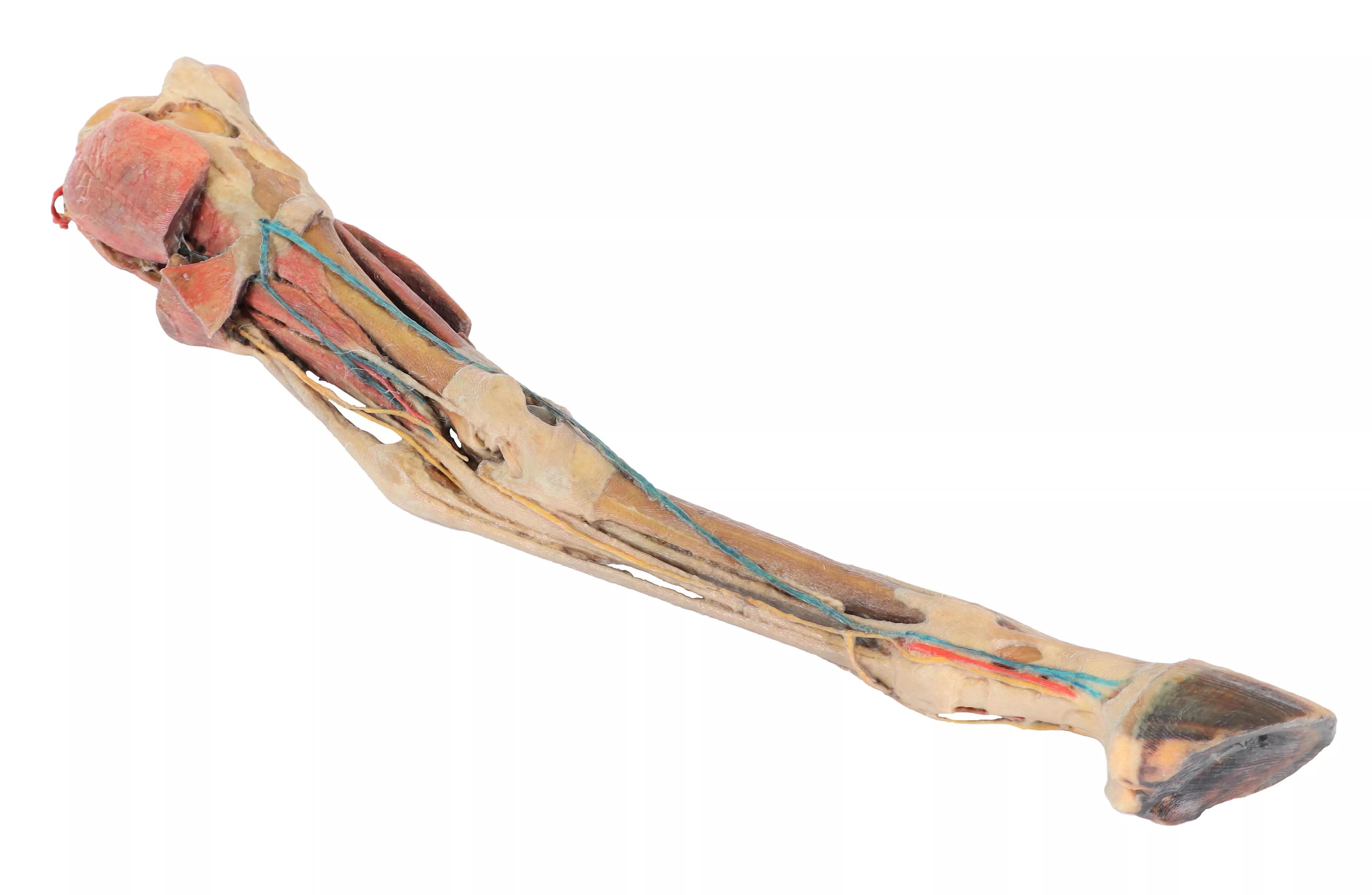
This specimen preserves a superficial dissection of the lower limb musculature from the midthigh to the hoof. The capsule of the stifle and tarsus joints has been opened to demonstrate the menisci, the main ligaments and the topography of the tendons. Muscles extensor and flexor of these joints as well as the foot joints have been dissected from the origin in the femur and tibia bones, to the insertions tendons in the tarsus, metatarsus and phalanges bones. Nerves and vessels have been dissected in the popliteal fossa, tarsus and digit regions. Detailed anatomical description on request.
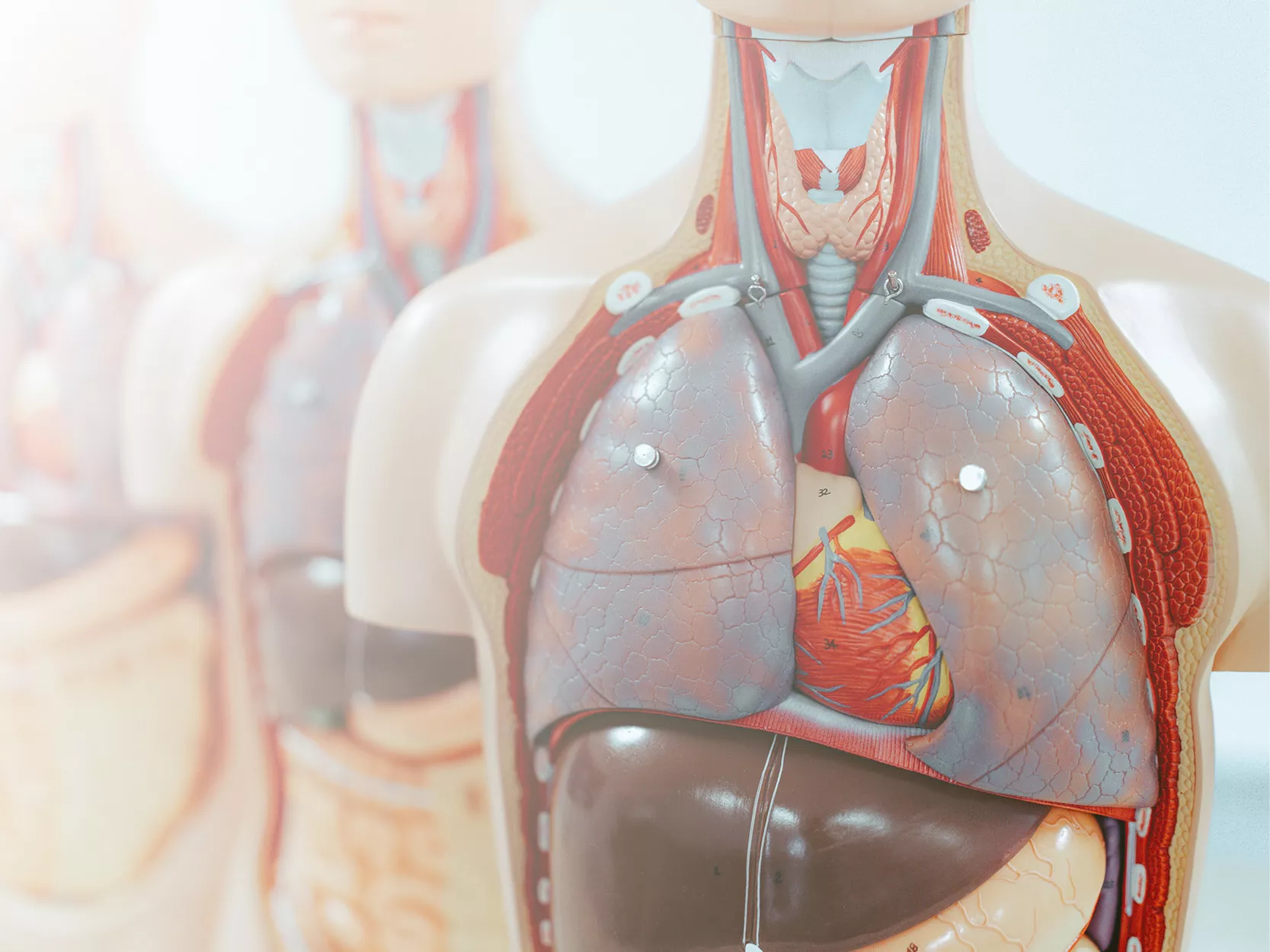
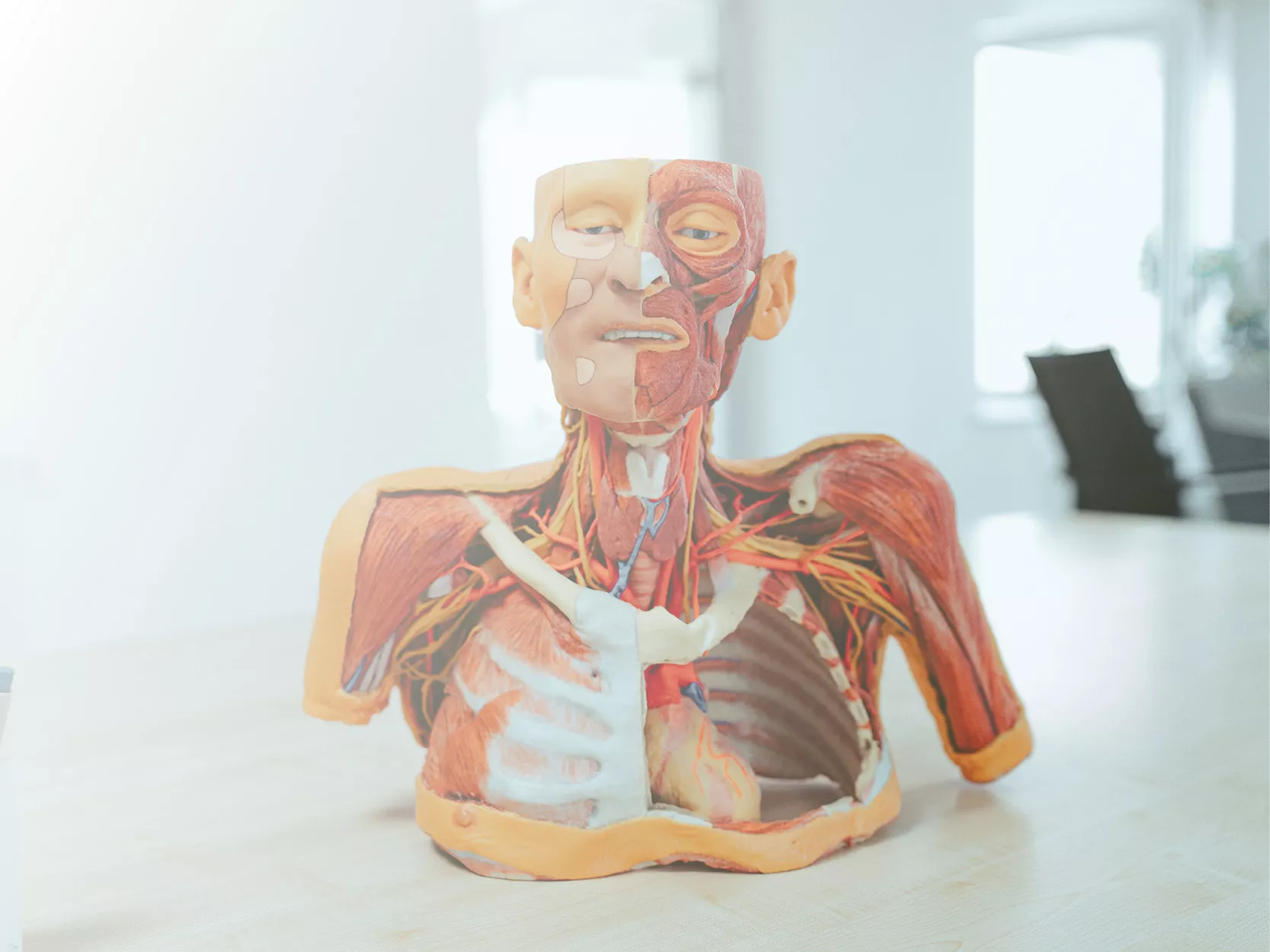
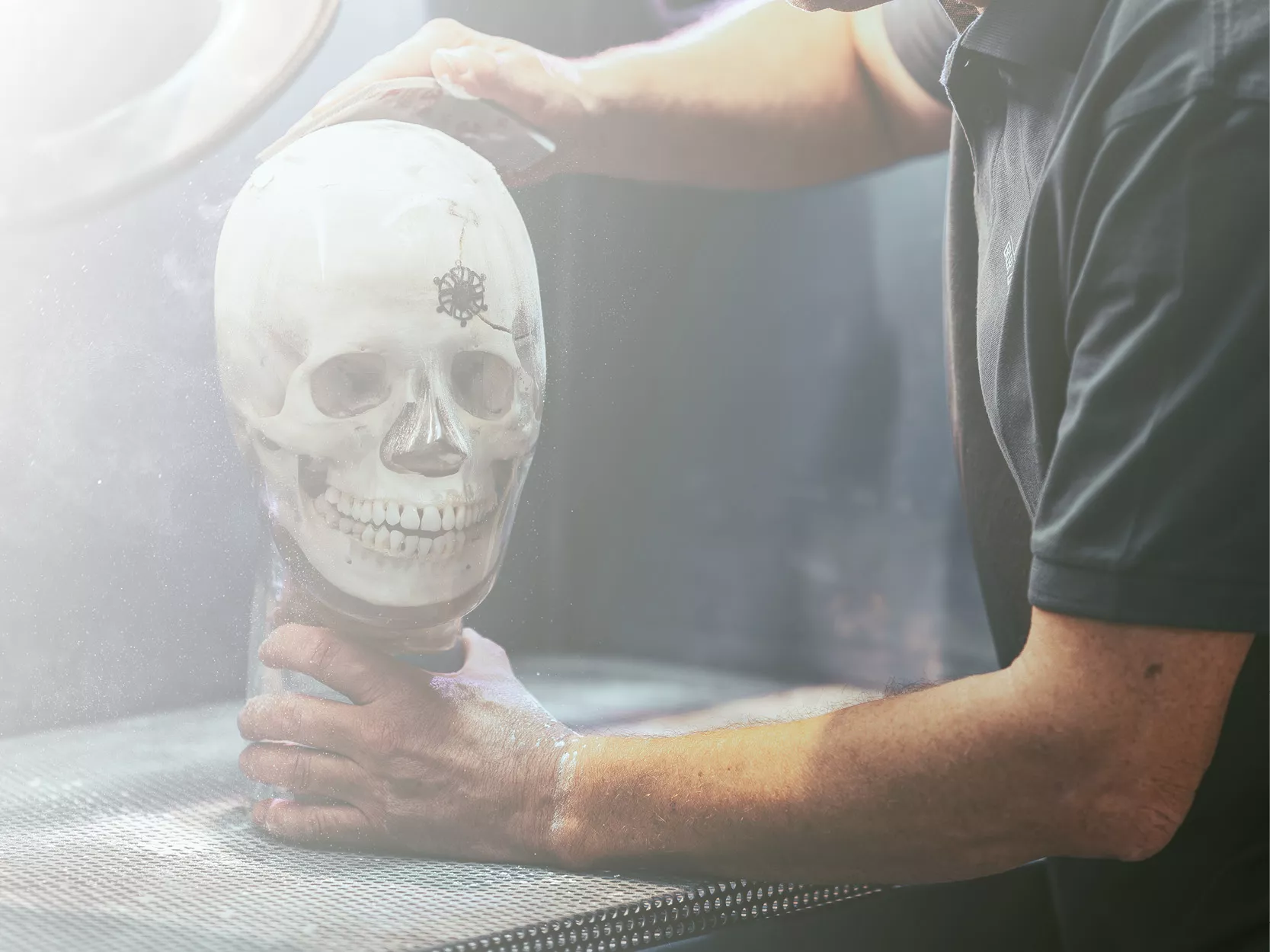
High-quality 3D printed anatomical specimens play a crucial role in enhancing the teaching and learning of clinical veterinary anatomy. Traditional methods of studying anatomy often rely on two-dimensional illustrations or preserved cadavers, which may not provide the depth and detail needed for a comprehensive understanding. 3D printing technology allows for the creation of accurate and intricate anatomical models that closely resemble real animal structures. These printed specimens offer a hands-on and tangible experience, enabling students to explore complex anatomical structures in a three-dimensional space. This tactile approach enhances spatial awareness, fosters better comprehension of anatomical relationships, and facilitates a more immersive learning experience. The accessibility of these high-quality 3D printed specimens make them an invaluable tool in advancing the education and training of veterinary professionals, ultimately contributing to improved clinical skills and better patient care.