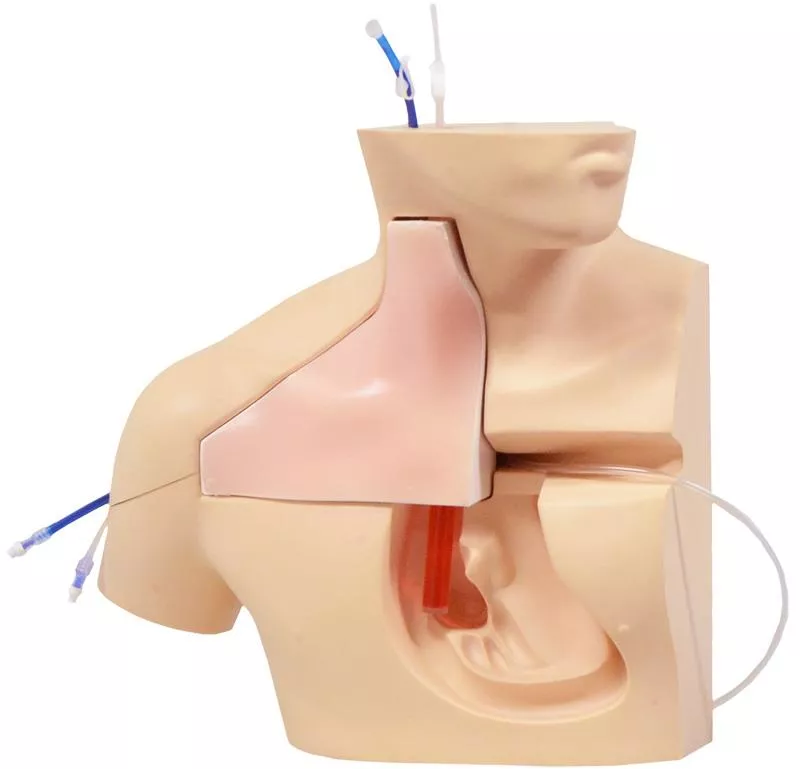
The Vascular Victor is a realistic training model for vascular access, specially developed for nursing education and clinical training. It provides a safe, hands-on environment to learn and practice both central and peripheral vascular access techniques professionally. Training OpportunitiesThe Vascular Victor features a variety of functional ports and catheters covering all relevant access systems:Implanted port system (central venous catheter) – realistic puncture, flushing, and dressing change.Peripheral port in the upper arm – for practicing care and handling of peripheral ports.Triple-lumen CVC (central venous catheter) – insertable via the subclavian or jugular vein.Tunneled CVC – for advanced nursing practice.PICC line in the basilic vein – realistic PICC training.Care of intravenous accesses on the forearm – e.g. dressing changes.Product AdvantagesRealistic training: Anatomically correct design with authentic tactile feedback.Safe practice: Repeatable exercises without any risk to real patients.Durable & easy to maintain: High-quality materials, easy to clean.Didactically well designed: Ideal for skills labs, nursing schools, and advanced training.Effective learning: Promotes routine, safety, and professional competence in handling vascular accesses. The Vascular Victor is ideally suited for nursing schools, training centers, skills labs, simulation centers, hospitals, clinics, and medical education institutes to enable realistic, hands-on training in vascular access techniques.
Enhanced training in ultrasound guided CVC. Axillary vein approach as well as internal jugular vein approach. An introductory training block to acquire basics of ultrasound guided puncture. Excellent image quality. Learning from failures; various complications can be simulated.- Effective for cannulation training; the only simulator with anatomically correct junctions of the subclavian veins with the right internal jugular and SVC.- This simulator includes three interchangeable pads for the puncture area, landmark puncture pad, ultrasound puncture pad and transparent cannulation block.- The trainee will learn three skills: how to make a safer puncture, how to avoid possible complications that may accompany the puncture, how to insert the catheter into the correct position. When the procedure is performed incorrectly, the error will show immediately by feedback.- Each training pad, placed at the right upper breast and right half of the neck covering the puncturing sites and catheter routes is a precise, life-size model incorporating the anatomical structure of bones, veins, arteries and upper lung.- The landmark puncture pad is designed to provide training in safely puncturing the subclavian vein or internal jugular vein, and inserting a catheter into SVC. Carotid artery pulsation is palpable.- The ultrasound puncture pad allows training in internal jugular vein puncturing under ultrasound scanning. Clear scanning image facilitates understanding of how to distinguish vein from artery and perform safe puncture while watching an ultrasound monitor.- A transparent block for three-dimensional anatomical understanding also works as an effective training tool for developing guide wire insertion skills.- Three CVC approaches with landmark method:1. subclavian vein approach2. supraclavicular approach3. internal jugular vein approach- Ultrasound guided CVC from internal jugular vein and axillary approach.- Thorough procedure from puncture to cannulation- Anatomical learningComplications indications:- Artery puncture- Pneumothorax- Mislodging/malposition
The CVC Insertion Simulator III provides training in a sequence of procedural skills from the needle insertion to catheter placement, including Seldinger technique. It provides training opportunities in an array of procedural skills from determining the insertion site to placement of the catheterwithout interruption. Both landmark and ultrasound-guided catheterization are possible in one pad.Features:- Repeated insertionThe improved frictionless tissue of the pad allows Seldinger technique and repeated insertion and removing of the catheter with less needle marks left on the surface of the pad.- Both landmark and ultrasound-guided CVC:The anatomically correct structure facilitate training in both landmark and ultrasound-guided CVC.- Mechanical complications, such as arterial puncture and pneumothorax can be simulated for training.- New materialThe close-to-human tissue material of the pad provides true-to-life sensation inserting the catheter.- Realistic venous collapseThe vein collapses under the pressure of the ultrasound probe.The pad shows the following anatomical structures:- Internal jugular vein & carotid artery- Subclavian vein & artery- Superior vena cava- Ribs- Sternum- LungTraining Skills:- Ultrasound-guided CVC- Landmark guided CVC- Ultrasound-guided venous access- Prevention of mechanical complicationsThe new and innovative material does provide an incredible realism and tactile excellence as well as ultrasound imaging quality. However, due to its special material, the injection pad has a limited shelf life once it is unpacked.
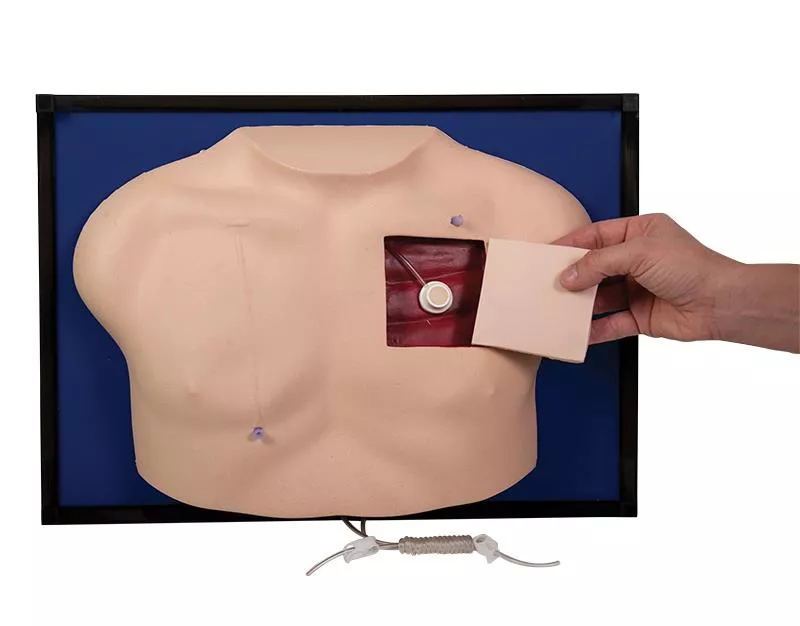
This model offers left and right subclavian catheter connections and an implanted PORT-A-CATH device. Both catheters may be flushed with water. Mounted on collapsible easel.Size: 57 x 46 x 13 cm, weight: 4.5 kg
Designed for practicing ultrasound guided central venous (CV) puncture as well as landmark puncture. It enables learners to identify the puncture site by recognizing the important landmarks. Simulated blood can be collected when a needle is inserted into the vein. Enables learners perform CV puncture by putting negative pressure on the syringe. Backflow air pressure indicates incorrect puncture of the lung. This trainer is designed for practicing exploratory puncture. Catheter and guide wire cannot be applied. Ultrasound guided central venous puncture utilizing an ultrasonography imaging system allows practicing the the internal jugular venous puncture, the subclavian venous puncture and the supraclavicular venous puncture. Pressure on the internal jugular vein by the ultrasound probe, causes the vein to become oval and deformed. Please note that the ultrasound imaging system works differently in the model than in the human body. Due to this the images you obtain with an ultrasound imaging system may differ from the real human body.
The Central Venous Catheter Trainer is a practical training model designed to learn, improve and refine central venous catheterization skills. Precise and realistic anatomical landmarks provide a highly realistic training experience while offering excellent value for money. The trainer enables learners to practice and perform the complete venous catheterization procedure, either under ultrasound guidance or using anatomical landmarks. The following venous access areas can be used for training: • Subclavian vein • Internal jugular vein • Supraclavicular vein Both the veins and clavicle are palpable and visible under ultrasound. This allows the Central Venous Catheter Trainer to support training using both ultrasound guidance and anatomical landmarks. Scope of Delivery • 1 Central Venous Catheter Trainer • 1 infusion bag for simulated blood • 1 vial of artificial blood powder • Instructions for setup, maintenance and use of the model The Central Venous Catheter Trainer provides a practical way to learn, practice and further develop skills in central venous catheterization.
Medical simulators - realistic training experiences for experts
Discover a revolutionary era in medical training with our state-of-the-art medical simulators.
Immerse yourself in realistic and risk-free medical simulations that allow trainee doctors, nurses and healthcare professionals to practise life-saving skills. The Erler-Zimmer simulators offer an interactive platform that integrates advanced technology such as augmented reality to provide hands-on experiences in a safe learning environment.
Invest in your medical education and choose our medical simulators for optimal training. Discover the future of medical training - practical, safe and state-of-the-art. Contact us today to find out more about our simulators and their possible applications.
Effective training of healthcare professionals is critical to patient safety and success in the healthcare sector. Our simulators allow aspiring professionals to perfect their skills, build confidence and prepare for real-life situations - all without risk to patients.
Prepare for real-life clinical challenges and enhance your skills with our innovative medical simulators - the future of medical education starts with medical simulators from Erler- Zimmer.